In this article
The useful question is not “How do I post more?” It is “What can someone do better after reading or using this?” A content business connects a specific audience, credible help, an owned relationship and an offer. A pocket product makes one part of that help usable without a meeting.
This is our working plan for connecting those ideas at Wealth Experiment. We have prepared two kits and public samples. Pricing and paid checkout are not active for these two kits. We have not yet established sales or customer outcomes from them.
What we took from Codie Sanchez’s content-business video
In “Don’t Become A Content Creator, Build A Content Business”, Sanchez organizes the approach around six Cs: channel, credibility, category, curate, calibrate and collect. Our strongest takeaways are choosing one place to reach people, showing the work behind your advice, and giving useful attention somewhere to go.
The transcript mixes practical advice with self-reported business results. We are treating those figures as the creator’s claims, not verified expectations for this experiment. Platform stereotypes and revenue ranges are not a reliable way to choose your own strategy. We will choose a channel from audience behavior and capacity, then measure our own results. Read our fuller video evaluation and creator playbook on Be an Influencer.
Build one useful path
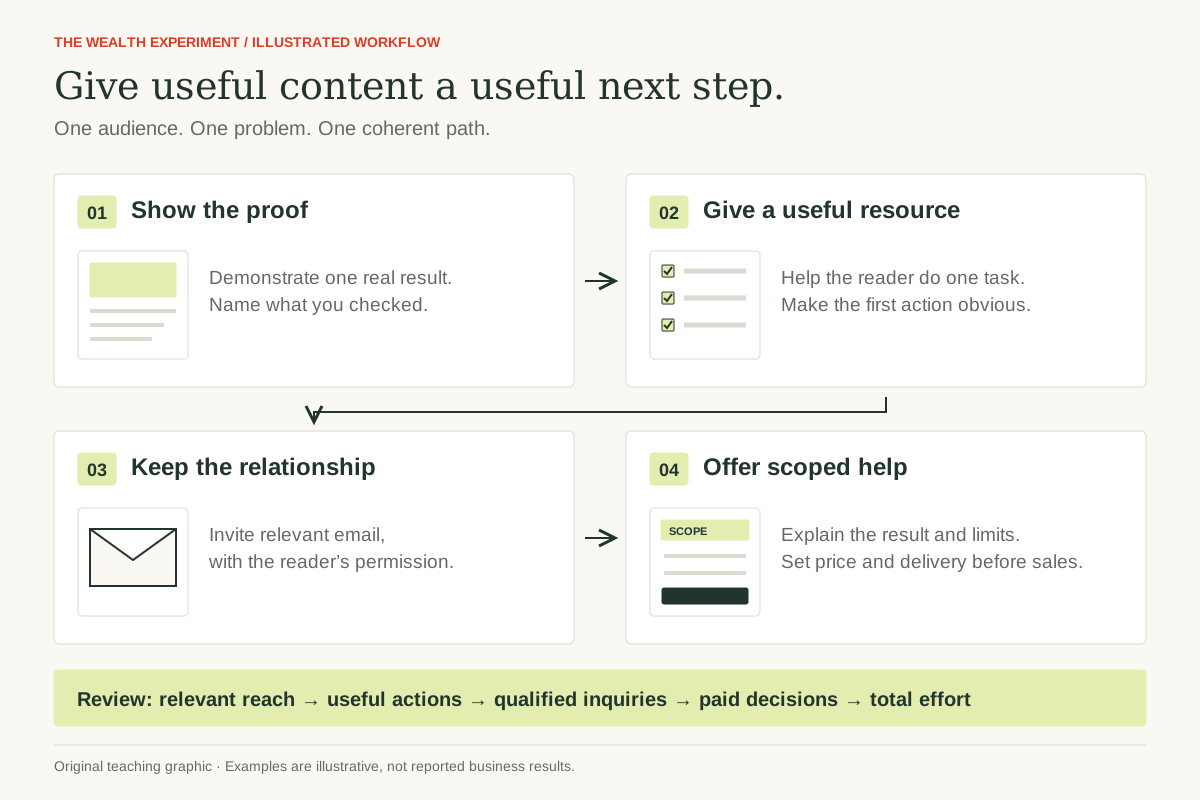
For this first experiment, our proposed audience is independent consultants and small service-business owners who want to make a repeated task easier. The content demonstrates a real workflow; the sample helps readers try one step; the full kit provides the reusable materials. If someone needs personal implementation, an existing scoped working session can be a separate option.
LinkedIn is a sensible initial test for Ashley’s professional audience, supported by an email list only where opt-in and delivery are working. This is a hypothesis, not a universal platform ranking. We will use one primary channel for 30 days before adding more.
Choose a problem that fits in a pocket
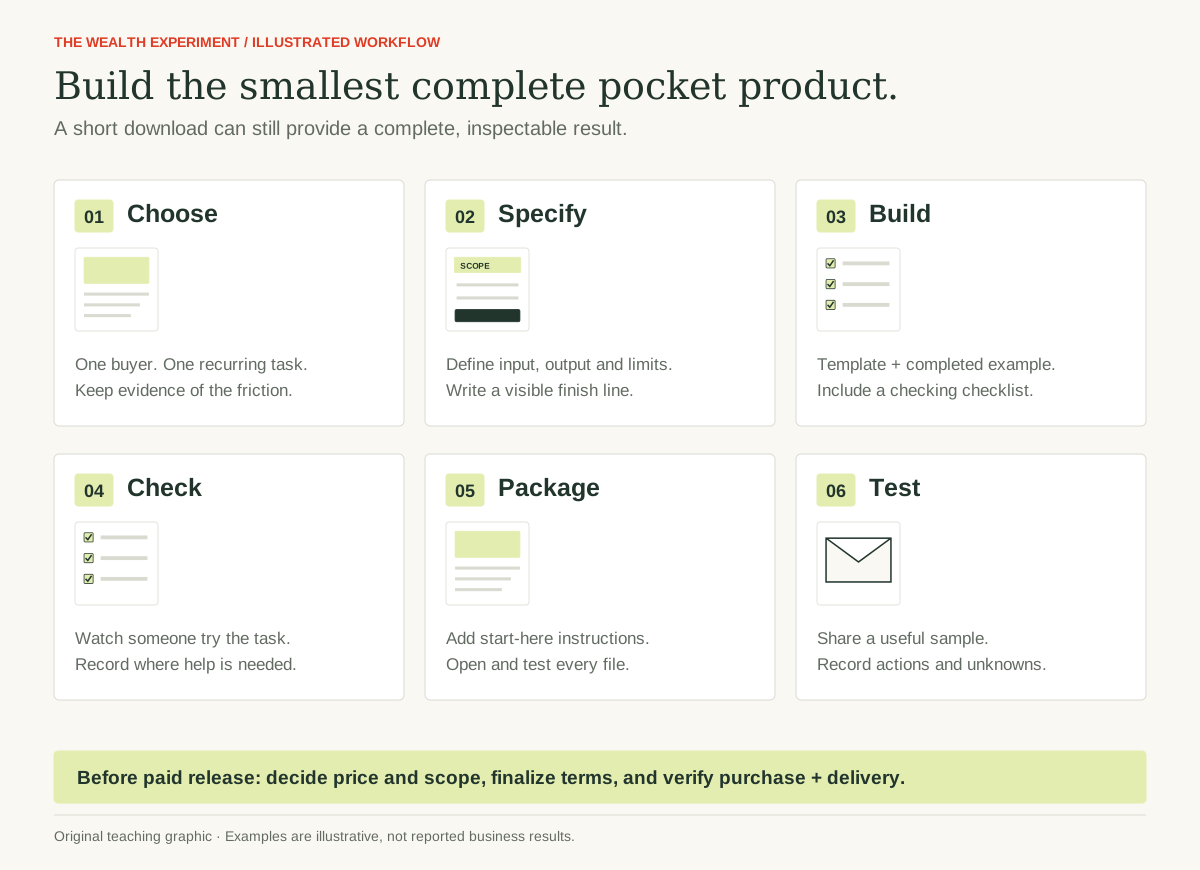
A pocket product is a small, self-contained digital resource for a narrow job: a useful template, checklist, mini workbook or set of scripts. “Learn marketing” is too broad. “Turn one sales call into a clear follow-up with an owner and next action” is small enough to build and test.
- Collect five real examples. Review questions from permitted client notes, teaching sessions or your own inbox. Remove personal information. Record the situation, current workaround and cost of getting it wrong.
- Choose one recurring task. Favor a problem people already spend time solving and where you have relevant experience. Record how often it occurs; do not assume a popular topic is a buying need.
- Define a visible finish. Write: “After using this, [person] can produce [specific artifact] for [situation].”
- Build the smallest complete version. Include instructions, a filled example, an editable blank and a quality check. A long prompt list without a usable result is not enough.
- Have someone attempt the task. Observe where they stop or need help. Fix those steps before adding more pages.
The two kits we are preparing
| Kit | Job it helps with | Start free |
|---|---|---|
| Content-to-Client Kit | Connect audience, proof, twelve content briefs and a permission-based follow-up path to one offer. | Three-page PDF sample |
| Pocket Product Launch Kit | Turn a recurring customer question into a scoped, editable product and a seven-day validation plan. | Three-page PDF sample |
These are distinct from the wider digital-product catalog. We are publishing samples first so people can understand the outcome and try part of the process. A free download is an interest signal; it does not establish willingness to pay.
A worked example: the meeting follow-up mini toolkit
Illustrative product concept, not a reported customer result. A freelance consultant finishes a discovery call and needs to turn scattered notes into a clear next step. The mini toolkit contains a notes-to-actions worksheet, a three-part email template, a decision log and a review checklist. Its promise is to help organize the follow-up; it does not promise booked work.
Start with a fictional meeting. Fill in the buyer’s stated problem, unanswered questions, agreed owner and agreed date. Draft the email using only those facts. Leave missing details marked “to confirm.” The blank template repeats the same structure. Ask a tester to use it on their own authorized notes and explain what confused them.
AI can help structure a draft or identify missing fields. Ask it to preserve uncertainty and flag missing information. A person still checks the facts, tone and commitments before sending anything. Use fictional or redacted notes when testing with a tool.
The 30-day experiment
| When | Do this | Evidence to keep |
|---|---|---|
| Days 1–7 | Choose one buyer and task. Finish a sample and a complete first draft. Ask three appropriate people to try the task. | Their own words, completion attempts and points of confusion. |
| Days 8–14 | Publish three useful demonstrations on one channel. Link each to the same sample with a distinct source tag. | Relevant visits, sample requests or downloads, and qualified replies. |
| Days 15–21 | Fix the main usability gap. Explain the kit’s scope, requirements and limits. Ask interested testers what would make it worth buying. | Specific purchase intent and objections, recorded separately from compliments. |
| Days 22–30 | Review the evidence and choose continue, change or pause. Set pricing only after reviewing scope, alternatives, effort and feedback. | A dated decision with costs and next test. Sales are only counted after a real paid transaction. |
Three testers and twelve posts are planning targets, not statistically reliable proof. If distribution reaches too few suitable people, the experiment is inconclusive. Change the way you reach the audience before declaring the problem invalid.
Measure the decision, not just the attention
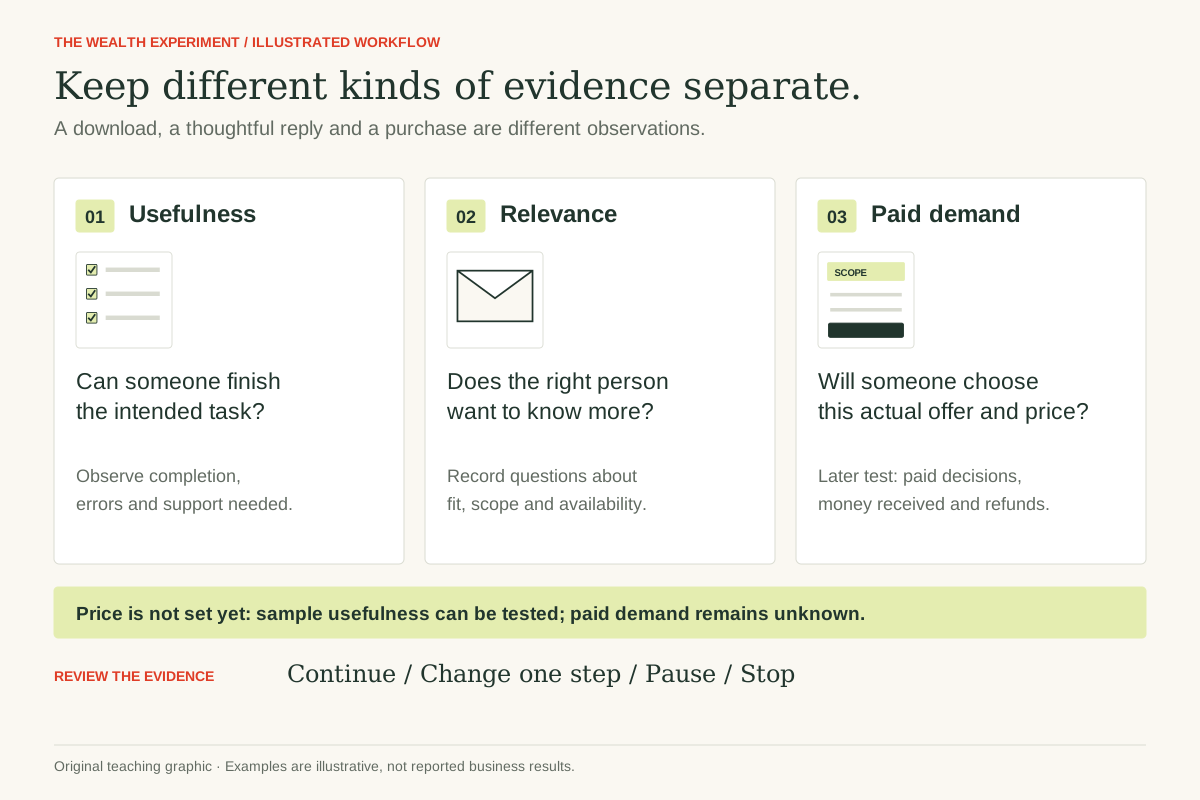
- Reach: how many people had a chance to see the content, using each platform’s definition.
- Relevant visits: people arriving at the intended page. Use consistent source tags and exclude your own tests where possible.
- Sample use: downloads are a proxy. Ask whether the person completed the task; do not equate a file request with use.
- Qualified inquiry: someone with the relevant problem discussing scope, timing or a next step. Define this before counting.
- Paid outcome: completed payment, adjusted for refunds. Keep it separate from revenue projections and purchase intent.
- Cost: record creation, editing, distribution and support time, plus software and payment fees when applicable.
For conversion rates, divide the relevant outcome by its matching starting group and show both counts. Ten sample downloads from fifty measured visits is 20%; it says nothing by itself about sales. Small samples are noisy. Compare like periods and sources rather than chasing a universal benchmark.
YouTube says CTR varies with audience, content and traffic source. Email opens can be distorted by privacy protections, and bots can inflate clicks. Use verified replies, task completion and completed purchases alongside platform metrics.
What we will publish next
The next update should show actual distribution dates, relevant visit counts, tester feedback, the changes we made and the next decision. We will keep “prepared,” “published,” “tested with people” and “sold” as separate states. At this stage, the two kit previews and samples are ready to explore; the paid products are not on sale.
Explore both pocket-product previews · Use the wider digital-product launch guide · Apply this to a service-business marketing funnel
Sources and further reading
- Codie Sanchez: content-business video — source framework; analysis based on its transcript.
- YouTube: impressions and click-through rate.
- Mailchimp: Apple Mail Privacy Protection and bot activity in reports.