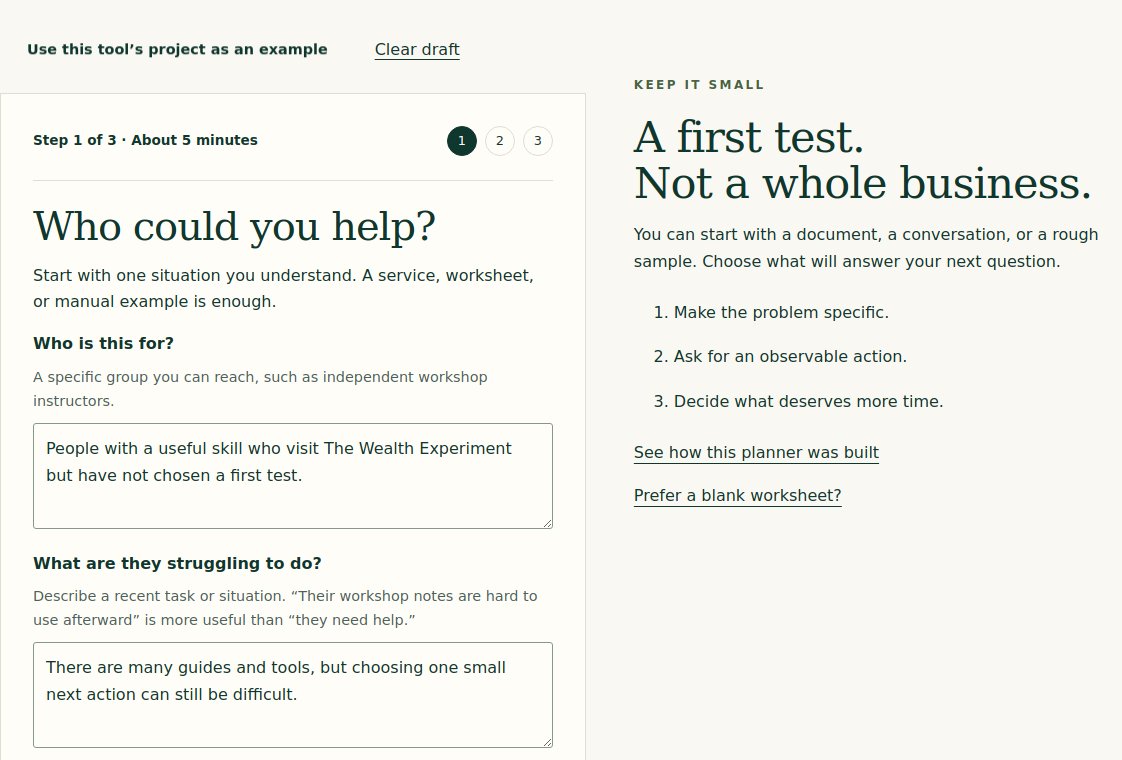
A real walkthrough of the First Experiment Planner: the problem, scope, design decisions, working result, and what still needs to be learned.
The working planner, with its own project loaded as an example. The sample time and budget limits are illustrative.
Current stage · First version ready to try
Inspect the work. Borrow the process.
The question: can a short guided activity help a reader leave with one specific action they feel ready to try?
Latest decision: ask for one audience, one useful thing, and one test before introducing a larger launch plan.
Next test: invite a small number of willing readers to try it and observe where they hesitate. Reader observations have not been collected for this release.
The site already had an offer builder, calculator, content planner, and Experiment Studio. Readers could use them independently, but still had to decide which question to answer first.
The first version
Three steps. One usable plan.
A short entry point now connects an audience and problem to a test, personal limits, and a review date. Readers can download the result or choose to save it locally.
The decisions behind the build
Follow the whole process.
01 · Validation
The initial problem was a design hypothesis: a broad resource library can leave a beginner unsure where to begin. The new planner is a test of that hypothesis. Its usefulness still needs reader evidence.
02 · Planning
Define a small outcome: one downloadable experiment brief. Exclude accounts, automated outreach, paid software requirements, market scores, and income predictions from this first version.
03 · Design
Use three short steps: make the problem specific, choose a test, and set limits. Explain the difference between the time to make a plan and the time to run it. Include an example that readers can edit.
04 · Coding with AI assistance
Use AI-assisted drafting and implementation to create a browser tool with prepared guidance. Keep the plan readable and portable. Saving is a deliberate choice, and the tool itself does not call an AI model.
05 · Testing
Check incomplete answers, number and date validation, returning to edit, saved-plan recovery, downloads, and smaller screens. Technical checks establish that the interactions work; reader tests are still needed to learn whether the guidance helps.
06 · Marketing
Give the tool a clear place on the homepage and in the toolkit, pair it with this walkthrough, and invite feedback. No paid campaign or reader-response result is claimed for this release.
What it actually took · Record dated October 9, 2026
The work, the limits, and the open record.
This is an implementation record. A measured time-and-spending report can be added when the underlying records are available.
Part of the work
What is documented
Delivered scope
Three-step planner, editable example, three test methods, export, optional local saving, progress checkmarks, and this walkthrough.
Tools and infrastructure
AI-assisted code and copy, HTML/CSS/JavaScript, the existing Python page generator, GitHub, and the existing Railway hosting service.
Scope revision
Keep the existing specialist tools; add a short entry activity that links to them. Use prepared guidance so visitors do not need an AI account to complete it.
Elapsed work and human review time
Not measured for publication. The 15-minute invitation is a suggested planning block for readers, not the build time.
Actual project spending
Not allocated. Hosting and AI subscriptions support other work; a documented allocation is needed before publishing a project total.
Reader feedback and commercial results
Not yet reported for this release. The example’s proposed test signal is not an achieved result.
Ongoing work
Observe willing readers, improve unclear questions, check exports and storage behavior after changes, and record support and maintenance effort.
Borrow the brief and adapt it to a problem you know: a workshop practice planner, a client onboarding checklist, or a service scoping tool. Start with one outcome and one person who can give useful feedback.
A 6-page scorecard for testing one income idea: the signal ladder, a four-week evidence log, the true-cost check, and a clear continue / change / pause decision. Download it now, with no signup required. You can also request occasional notes from Ashley’s experiments.