In this article
The most useful part of Spotify’s AI-agent story for a small business owner is surprisingly ordinary: organize the work, make expectations clear, and check the result. You do not need a fleet of software services to try that idea. You need one recurring job that somebody values.
Spotify’s June 3, 2026 engineering article describes a company using AI coding tools at remarkable scale: more than 99% of engineers use them weekly, 94% report greater productivity, and pull-request frequency increased 76%. These are Spotify’s figures, not our results or a prediction for your business. More changes also create more work to review.
Borrow the operating habit
Spotify combines a catalog of software and ownership, an orchestration system for maintenance, a background coding agent called Honk, and standards that give immediate feedback. It invested in much of that foundation before agents arrived. The small-business equivalent is a clear inventory of your projects, a repeatable brief, a controlled place to make changes and a checklist for acceptance.
That matters when you run several websites or deliver services to clients. Each project can have a different tone, technology, offer and approval process. Without a reliable map, an agent may act on the wrong assumptions. A single table listing the site, its purpose, source location, reviewer and testing steps can prevent a surprising amount of confusion.
This is an experiment we can use to assess a workflow. It is not a claim that our portfolio already operates like Spotify or that agents have generated revenue for it.
1. Pick a deliverable with a real finish line
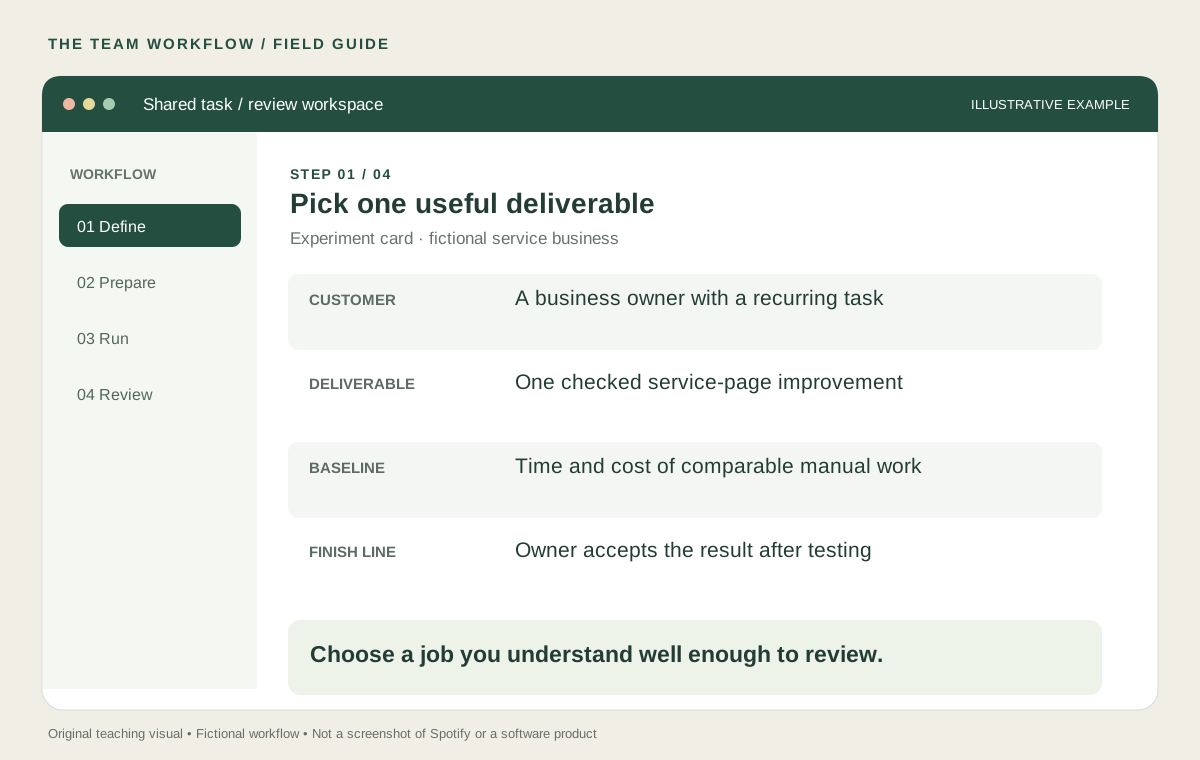
Choose something narrow: fix one broken service-page interaction, turn a verified checklist into a useful page, or update a documented component. Avoid starting with an entire business, a new payment system or a large platform migration. The job should be familiar enough that you can judge whether the result works.
In our fictional example, a service business wants one page’s inquiry button and confirmation message improved. The owner supplies the actual booking process and approved copy. Completion means the link works, the message accurately describes what happens next, the page works on a phone, and the owner accepts it.
Before involving AI, estimate or measure how long comparable manual work takes. Record the job’s scope and complexity. A five-minute typo fix is not a fair comparison with a redesigned inquiry journey.
2. Turn scattered knowledge into a reusable folder
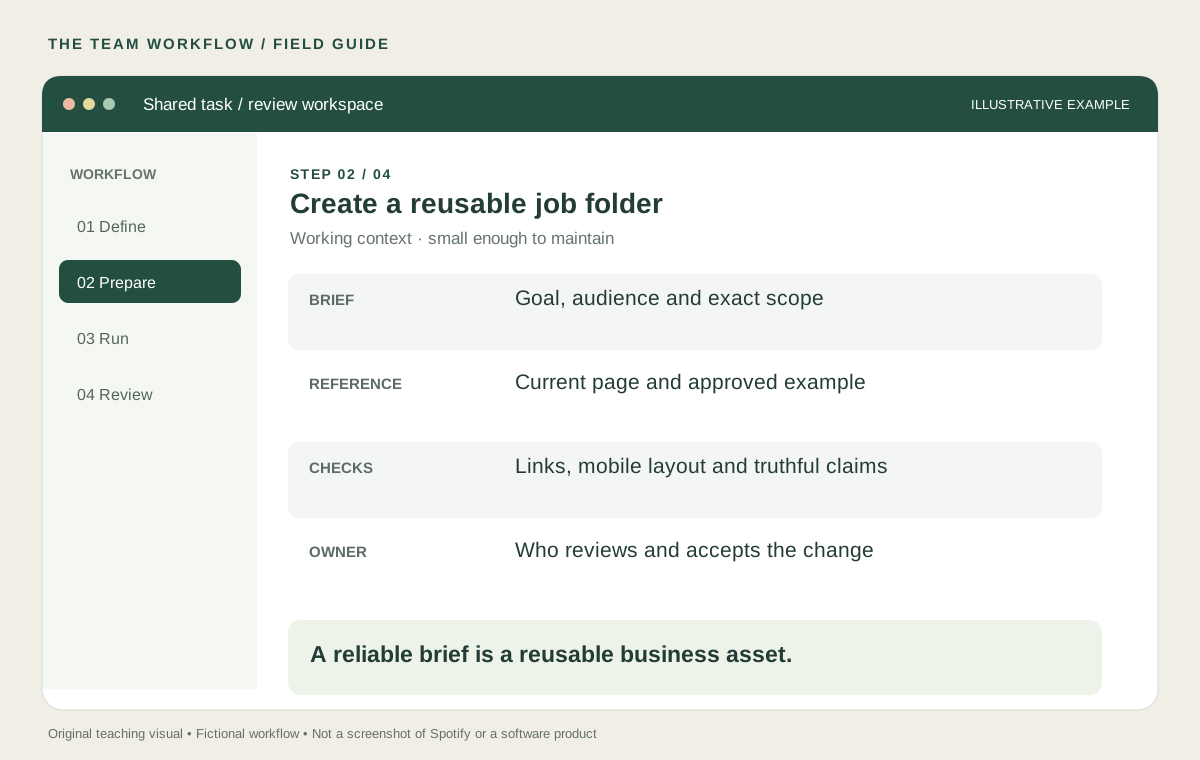
Create a brief, current source materials, one good example and a review checklist. Include the desired outcome, who the page serves, the tone, exact boundaries and what requires a decision. If the business has not chosen a booking policy, the agent should mark it as missing rather than invent one.
Keep this folder current. An old price, an expired event date or a retired URL can travel through an otherwise polished workflow. Assign a person to update the source and add the date it was last checked. Use the minimum information needed for the task.
Practical tip: name the files by purpose—brief, approved facts, reference, checks and handoff. The point is that another person can pick up the job and understand it. The same clarity helps an agent.
3. Run the job, then count the whole effort
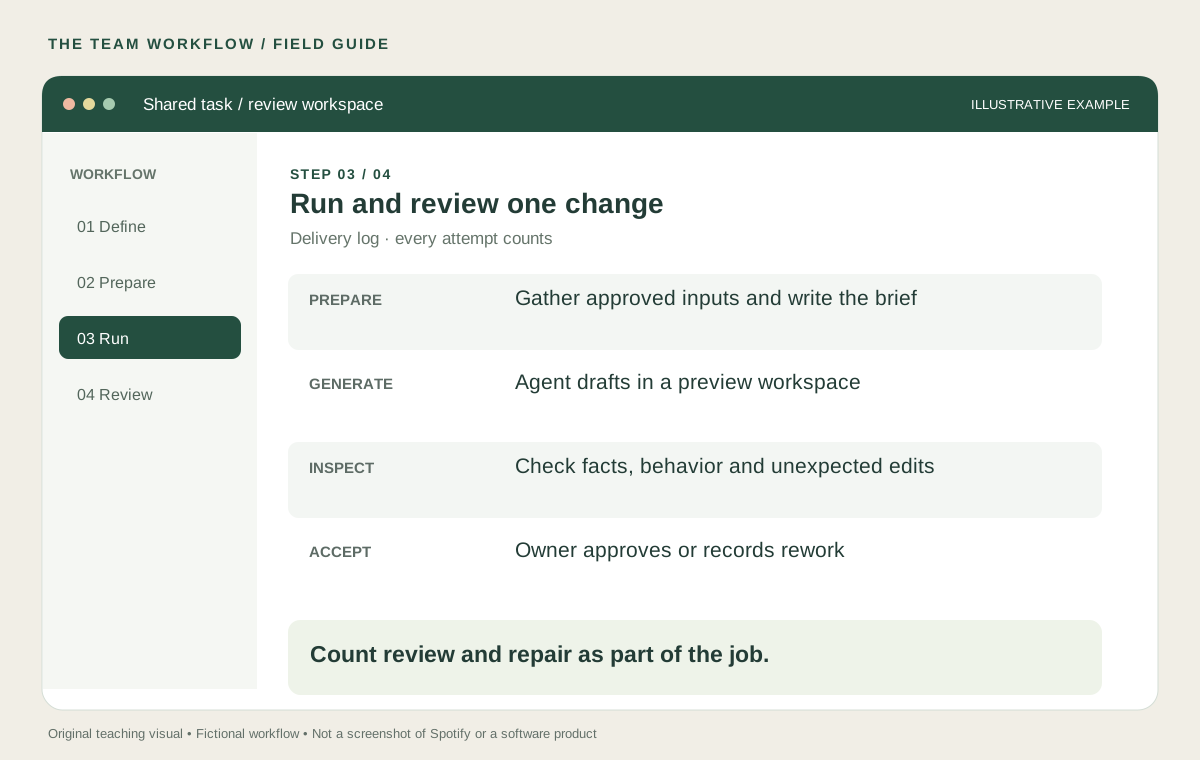
Have the agent propose a small change in a preview or separate branch. Ask it to identify the files it changed, show the checks it ran, and explain anything it could not verify. Review the actual page and behavior before publication.
Use a timer for preparation, review and corrections. Record model or tool charges and any paid human help. Include failed attempts. The attractive number is often generation time; the useful number is the time and money required to reach an accepted result.
If the result needs repeated repair, identify why. Missing context may call for a better brief. Repeated mechanical work may be better served by a script or template. Unreliable judgment may mean the task should stay with a person. Stopping a poor workflow is a valid experiment outcome.
4. Calculate whether repetition makes it worthwhile
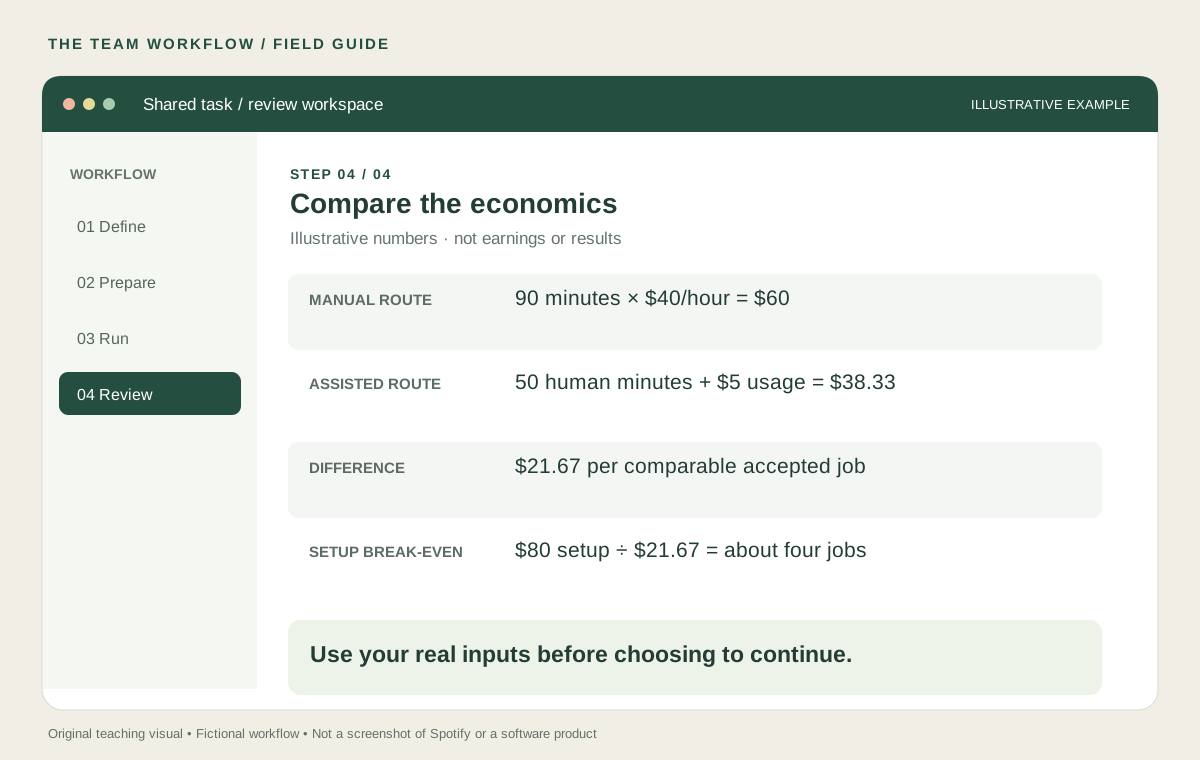
Here is an illustrative calculation, not an earnings claim. Suppose the manual job takes 90 minutes. At a chosen planning rate of $40 an hour, that is $60 of time. The assisted route takes 15 minutes to prepare, 20 minutes to review and 15 minutes to repair: 50 human minutes, valued at $33.33, plus $5 of tool usage. Its direct total is $38.33.
The apparent difference is $21.67 per comparable accepted job. If setting up the workflow took two hours valued at $80, it would take about four jobs to recover that setup cost, assuming the same quality and effort each time. Those assumptions must be tested. Allocate subscriptions, maintenance and any other relevant overhead separately.
Time valued in a worksheet is not automatically cash saved. If you still pay the same salary or subscription, the benefit may be available capacity. It becomes business value when you use that capacity to serve customers, improve delivery or perform work that matters.
Could this become a service?
Possibly—but start with the customer’s problem. A clear service might be a scoped improvement to a recurring website task with testing and a written handoff. “We use agents” is a delivery method, not the buyer’s outcome. Confirm demand and scope before treating a fast prototype as a product.
For a paid job, compare the collected fee with all delivery costs, including acquisition, communication, review and support. A lower drafting cost does not establish profitability. Avoid quoting Spotify’s enterprise results as evidence for your own promised turnaround.
A five-day starting plan
- Monday: choose the task, finish line and baseline.
- Tuesday: assemble the brief, reference and checklist.
- Wednesday: complete one assisted attempt and log all effort.
- Thursday: review the result with the person who will use it; record repairs.
- Friday: compare cost, quality and usefulness. Repeat once with a similar task before expanding.
Copy this working brief
The person using this is [audience].
They need to [one useful task].
Use these approved facts and examples: [references].
Change only [scope]. Keep [constraints] intact.
Show a preview and list the checks you actually ran.
If a required fact is missing, ask or mark it unresolved.
Return the result, changed files and a short review checklist.
Spotify’s story is a reminder that organization can compound the value of better tools. For a small business, the most revealing next step is one complete, measured job—from a clear request to something another person can use.
Source
Spotify Engineering: Coding Is No Longer the Constraint, June 3, 2026. The service scenario, cost assumptions and five-day experiment are original illustrative applications.
Choose your next practical guide
- What Spotify’s coding agents teach us about building a better delivery system
- When AI makes coding faster, product decisions become the bottleneck
Your next move
Choose one recurring job, write its acceptance checks, and record the full cost of one reviewed attempt.