In this article
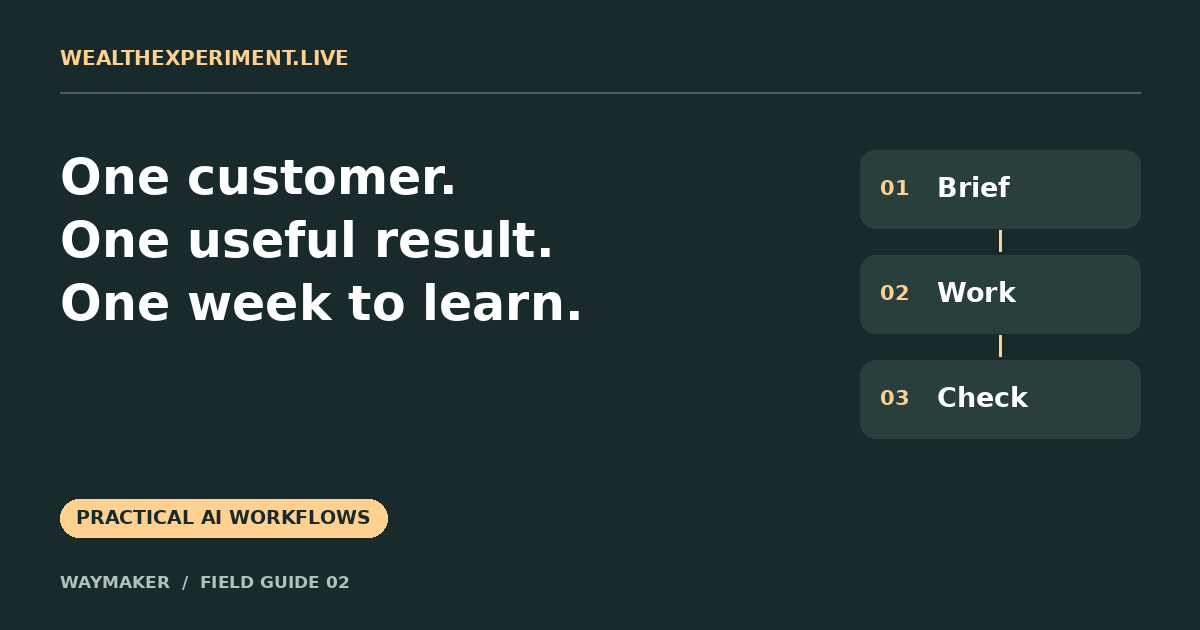
You can spend a week connecting tools and still have nothing a customer wants. A better first experiment starts with a small promise: help one kind of person make one decision or complete one task.
For this example, imagine a service that reviews the clarity of a local business’s booking page. The result is a short, annotated review with three prioritized changes. AI helps collect observations and organize the report. You bring the understanding of the customer, the business, and what is worth changing. This is an example to test, not a claim of proven demand or earnings.
Write the offer before opening the tools
Define the customer narrowly enough that you can find them: independent service businesses with an existing booking page. Define the deliverable just as clearly: one page reviewed, three recommendations, and a short explanation of what to address first.
Avoid promising more bookings from an inspection alone. You can promise a completed review with specific evidence. Any claim about improved conversion requires implementation, measurement, and enough context to interpret the result.
Give the week a learning goal
| Day | Work | Evidence to keep |
|---|---|---|
| Monday | Choose the customer and write the offer | One sentence describing the problem and deliverable |
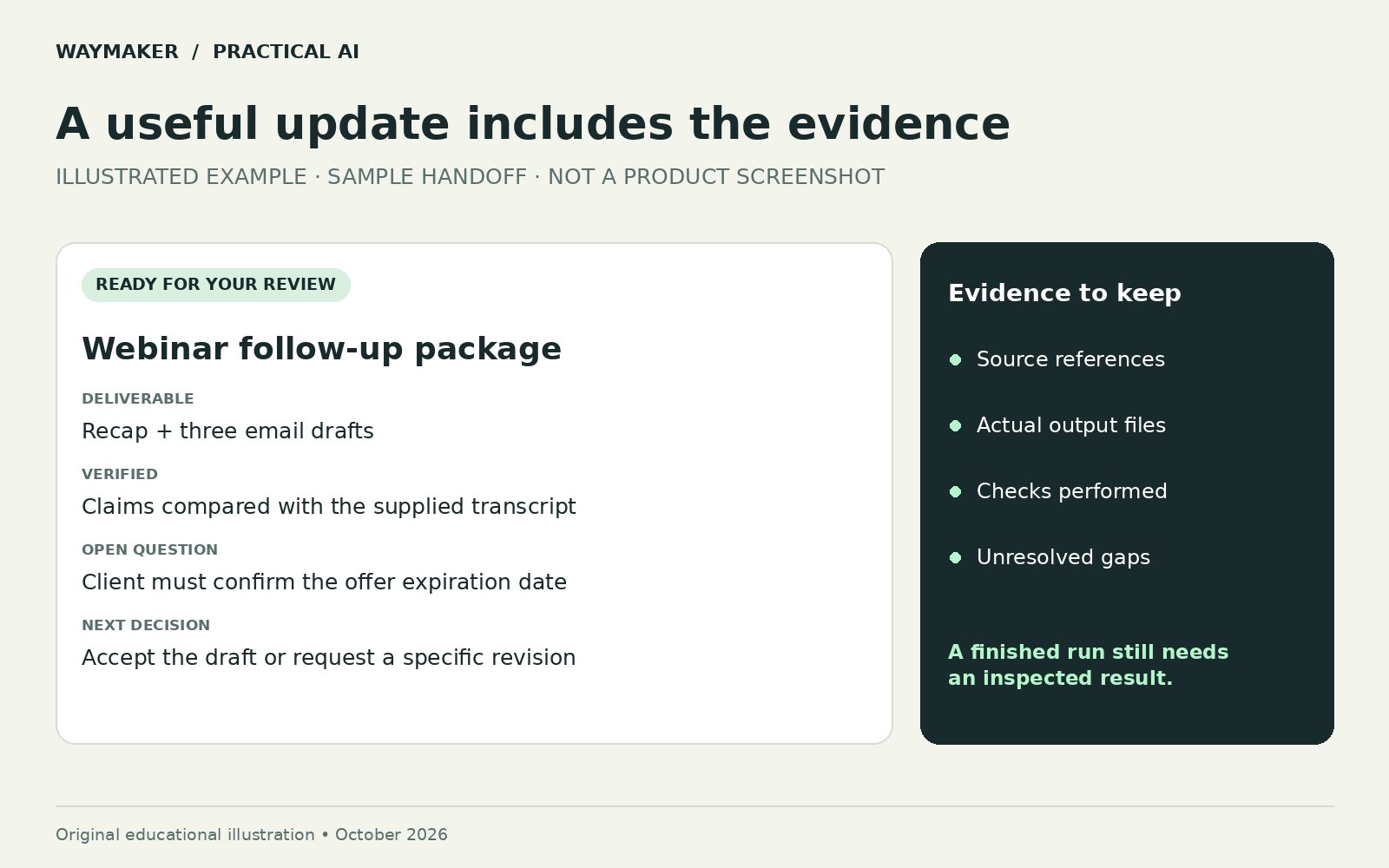
| Tuesday | Create a sample from a permitted public page | Observed friction with screenshots or exact references |
| Wednesday | Check the sample yourself | Corrections and review time |
| Thursday | Discuss it with potential customers | Their words, questions, and objections |
| Friday | Decide what to repeat, change, or stop | Evidence for the next experiment |
Aim for a small number of real conversations you can handle well. Ask whether the problem occurs, how they deal with it now, and what would make the deliverable useful. A polite compliment is weaker evidence than someone requesting a review of their own page. A paid pilot is stronger evidence of willingness to pay, but one sale still does not prove repeatability.
Use AI to produce something you can show
Help me test a booking-page clarity review for local service businesses.
Use this one public URL and the customer description I provide.
Produce a sample with three observations, each tied to a visible page detail.
Explain the possible customer confusion and suggest a specific improvement.
Label interpretations as hypotheses. Do not invent visitor data or revenue.
Do not submit forms, contact the business, or change its website.
Finish with a review checklist and a list of information a paid pilot would need.
Read the result as if you were paying for it. Is the advice particular to this page? Can the owner act on it? Does the report identify the most important problem, or simply list everything that could be different? Rewrite generic advice until the recommendation earns its place.
Where Dot and Work could help
For the experiment, assign Dot the task list and unanswered questions, use Work to prepare the sample, and use an approved browser connection when the page needs visual inspection. These are proposed responsibilities, not a claim that the exact service has been automated. The companion guide explains setup and the difference between local and cloud work.
Keep customer feedback in a simple file that you control. Record exact quotes only with appropriate permission, remove unnecessary personal information, and connect each proposed change to something learned. This helps prevent enthusiasm for the tools from replacing evidence about the customer.
Count the whole job
Record time spent preparing, checking, revising, and delivering the sample. Add software costs that are attributable to the experiment. For a paid pilot, calculate the amount left after those costs and the value of your time. This is a planning calculation, not an income forecast.
You might discover that AI can draft the report quickly, but you need considerable time to verify page behavior. That finding can change the offer: fewer pages, a clearer scope, better source materials, or a higher price. It can also be a good reason to stop the idea.
Make a decision before adding automation
At the end of the week, choose one path. Repeat when the problem is clear and the deliverable is useful. Revise when customers care but the scope or result needs work. Stop when access, economics, or demand makes the service unattractive. Keep the sample and lessons even if you stop; they can inform a better experiment.
A finished experiment gives you an offer, a sample, a record of customer reactions, and a reason for what comes next. That is enough progress to justify a second week. You do not need an elaborate agent team before you have those basics.
Build a first version with support in Two Mondays to a Side Hustle. The current free founding cohort is November 2 and 9, 2026, 7–9 p.m. Eastern, with 20 live seats. Places are confirmed by email; check the registration page for availability.
Companion guide: how Dot, Work, and browser access fit together.
Your next move
Choose one customer problem and one deliverable. Record the work, feedback, costs, and your next decision.