In this article
Put AI to Work · From ideas to results
The most useful AI income experiment tests whether a specific person will pay for a specific outcome you can deliver at a sustainable cost. Start with something you understand, set a limit on money and time, ask for a meaningful commitment, and record what happens. AI can accelerate research and delivery. It cannot make demand appear or turn a forecast into evidence.
Income is money coming in. Profit accounts for expenses. Wealth is what you retain and build over time, after obligations and risk. A sales screenshot proves none of those by itself. This guide focuses on testing an income-producing business, not predicting investment returns. All prices, targets and results in the worked example below are hypothetical teaching inputs, not reported Wealth Experiment earnings.
1. What is practical, what is hard, and what is probably hype?
These are editorial judgments about how easy an idea is to test, not measured success rates. A useful service can fail; a difficult product can succeed. Ask what evidence would change your mind.
| Opportunity | Why it may work | Hard part and smallest test |
|---|---|---|
| AI-assisted services grounded in an existing skill | A buyer already needs editing, reporting, design, customer research or operational help. | Quality and acquiring customers still matter. Offer one clearly scoped paid pilot with a sample and acceptance checklist. |
| Workflow implementation and training | A team may pay to reduce a recurring bottleneck and learn a repeatable process. | Integration, privacy and ongoing support. Observe the current workflow; compare one reviewed output and total human time before and after. |
| Niche templates and small digital products | A reusable resource can help with a narrow, recurring job. | Distribution, differentiation and support. Let intended users try one sample; offer the complete version with transparent contents and price. |
| Micro-SaaS, agents sold as a service, or AI apps | Recurring utility can support recurring payments. | Reliability, retention, inference costs, security and support are difficult. Deliver the service manually to a few customers before automating it. |
| Affiliate publishing, social channels and newsletters | Useful expertise can build trust and introduce relevant products. | Audience building takes time; algorithms and commissions change. Publish an original comparison, distribute it to a relevant audience, and track qualified actions and net commissions. |
| AI dropshipping, print-on-demand, courses or site flipping | There can be a real product, skill or asset to sell. | Customer acquisition, fulfillment, refunds, rights, maintenance and buyer due diligence. Test one offer and its full costs before creating a catalog. |
| Guaranteed passive income, copy-paste riches, bots that never need oversight | The claim is appealing; that is not evidence. | Reject guarantees. Require verifiable revenue and expenses, customer demand, hours, failures and a repeatable acquisition method. Do not buy a large tool stack to reproduce a screenshot. |
“AI made this in ten minutes” describes production time, not sales, delivery, refunds or profit. Automated trading and guaranteed-return bots are not substitutes for a customer experiment. More bots do not create more buyers.
2. Find a niche and a persona using real behavior
Begin with your skills, customer access and weekly capacity. Builder DNA can help you reflect on preferred ways of working; it is not a prediction of commercial success. List three audiences you can actually reach and three expensive, frustrating or repetitive jobs each audience performs.
- Collect evidence: read relevant public reviews, job descriptions, forums and competitor offers. Record the URL, date, exact problem and context. A listed price is evidence of an offer, not proof of sales.
- Talk with five potential buyers: ask “Tell me about the last time this happened,” “What did you do?” and “What did it cost in time or money?” Ask who approves spending and what triggers action.
- Write a behavioral persona: role, triggering event, job to complete, current workaround, budget authority, objection and reachable channel. Avoid invented demographic details.
- Compare alternatives: doing nothing, doing it manually, hiring help and existing software. Define why switching would be worth the effort.
- Score your options: buyer access, recurring pain, evidence of spending, delivery ability and fit with your time, each from 1–5. The score organizes judgment; it does not validate the market.
Example persona hypothesis: an independent consultant who has completed a discovery call but loses an evening preparing the proposal. The person wants a clear scope and next step, uses previous documents as a workaround, and approves their own spending. Validate those statements in conversations before treating them as facts.
Research prompt: Using only these sources and anonymized interview notes, identify three recurring jobs people struggle with. For each, show the evidence, source/date, current workaround, likely buyer and unknowns. Separate observations from assumptions. Do not invent quotes, market size, search volume or willingness to pay. Suggest the next question that could disprove each idea.
Continue in the Research Desk, Builder DNA, and niche-selection guide.
3. Turn the idea into a testable experiment
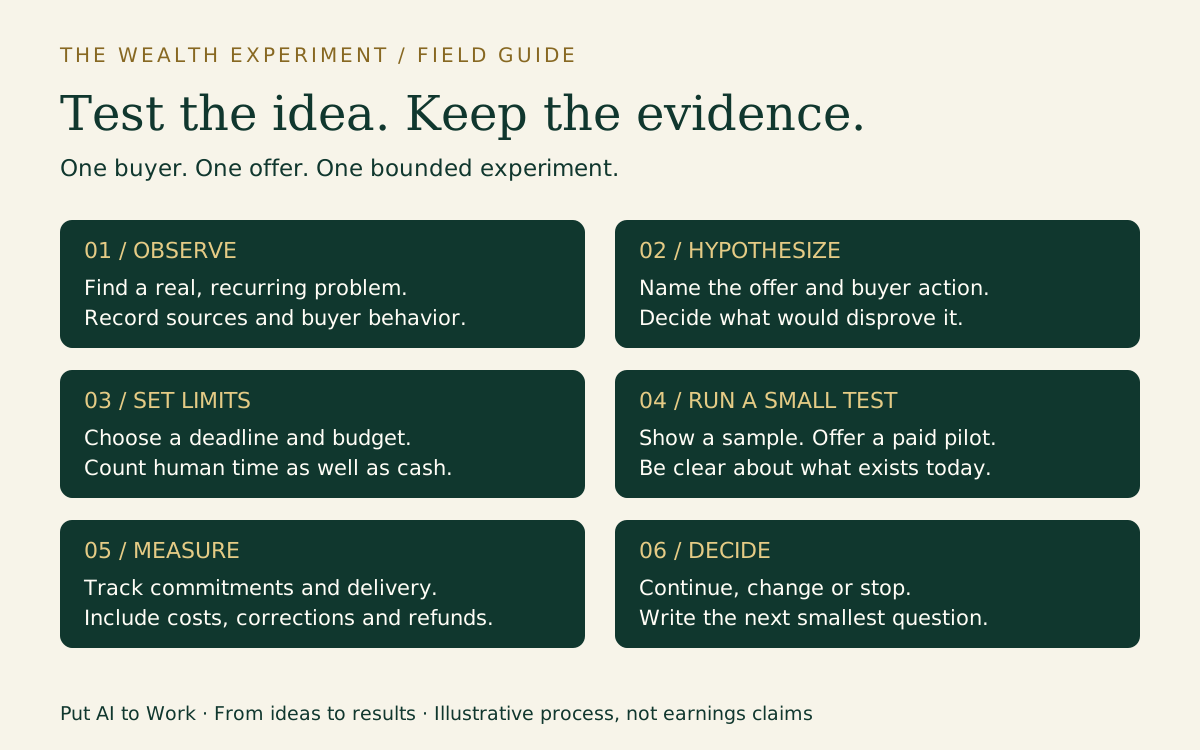
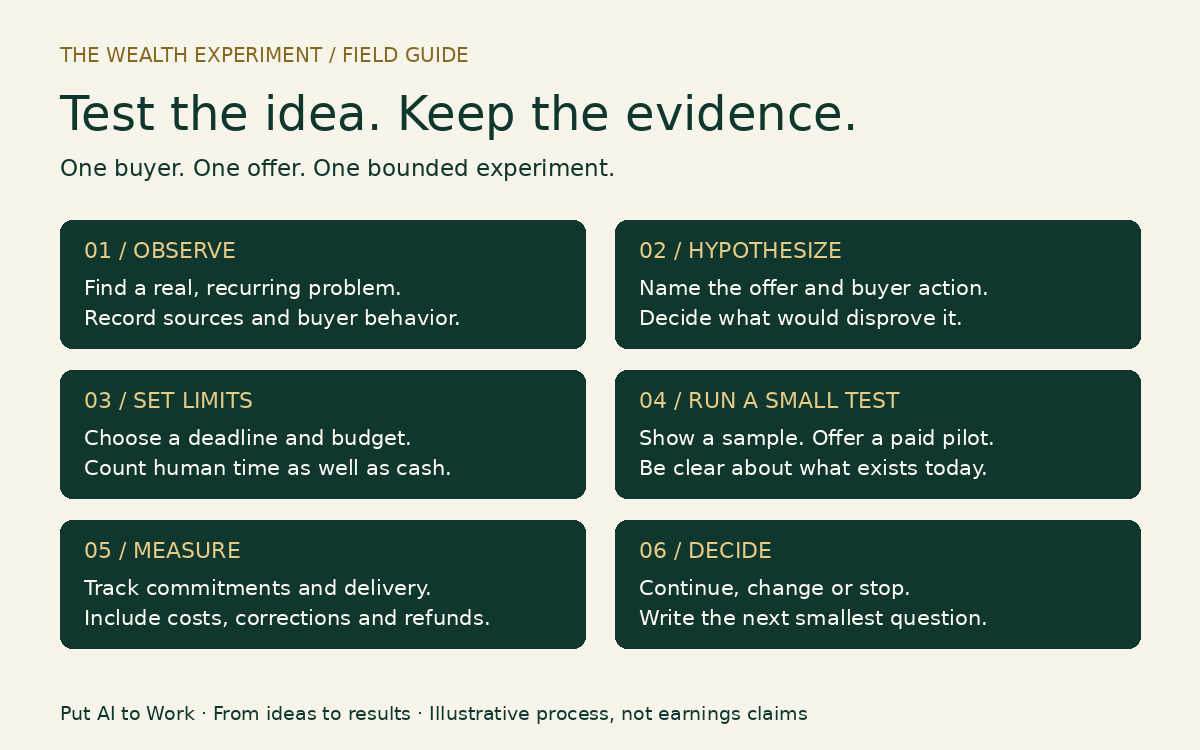
Use this sentence: We believe [buyer] will [observable action] for [offer and price] because [problem]. By [date], we will test this with [method], spending at most [cash] and [hours]. We will continue if [threshold], change if [signal], and stop if [limit].
Choose the riskiest assumption first. If you do not know whether buyers care, a polished app is the wrong first test. If people want the outcome but you cannot deliver it reliably, run a delivery test. If delivery works but buyers cannot find you, test a channel.
- Problem interview: reveals past behavior and alternatives; compliments do not establish demand.
- Prototype or sample: tests whether people understand and can use an output; usability is not willingness to pay.
- Landing page: tests response to a specific offer and traffic source. A waitlist is weaker evidence than a purchase.
- Paid concierge pilot: tests buying and delivery while a human does the work. State scope, delivery date, revisions and refund terms clearly.
- Repeat use or renewal: tests ongoing value. One purchase does not establish retention.
Never fake a checkout, testimonial or inventory shortage. If a product is not available yet, say so. For a preorder, explain what exists, what will be delivered, when, and how cancellation works.
4. A worked 14-day test: proposal preparation for consultants
Illustrative offer: turn a consultant’s approved, anonymized discovery notes into a draft scope, proposal and follow-up message for $150. The consultant reviews and sends everything. This is an example to adapt, not a new advertised Wealth Experiment service.
- Days 1–3: interview five consultants. Look for recent proposal work, current effort and real buying constraints. Create one sample using fictional client details.
- Days 4–5: write a one-page offer with deliverables, exclusions and a two-business-day delivery target. Set an experimental ceiling of $50 cash and eight hours, including interviews, selling, delivery and review.
- Days 6–10: personally invite up to ten relevant, reachable prospects to review the sample. Respect channel rules and declines. Log invitations, responses, qualified conversations and payments separately.
- Days 11–13: deliver any agreed pilots. Record corrections, total effort, acceptance and whether the client would buy again. Stop accepting pilots if the effort ceiling is reached.
- Day 14: review. A proposed continue threshold is two paid pilots delivered within the limits, both accepted against the checklist. One pilot is promising but inconclusive. No purchases after qualified conversations means inspect objections before building more. No conversations means the channel has not tested demand.
Those thresholds are decision rules chosen for this example, not universal benchmarks or statistical proof. You may learn that $150 is too low, that the task needs more expertise, or that consultants prefer a reusable template. That is useful evidence.
Hypothetical cost check: two $150 pilots produce $300 revenue. Subtract $50 in direct costs to leave $250 before fixed overhead, taxes and owner labor. Eight hours means $31.25 per hour before those items. If you value those hours at $40, the labor-adjusted result is negative $70 before remaining overhead and tax. A positive cash result can still be an unattractive use of time. Include unsuccessful outreach and setup in the hours.
Download the experiment worksheet and prompts, or start in the First Experiment Planner and Experiment Studio.
5. Build an agent team with clear roles and handoffs
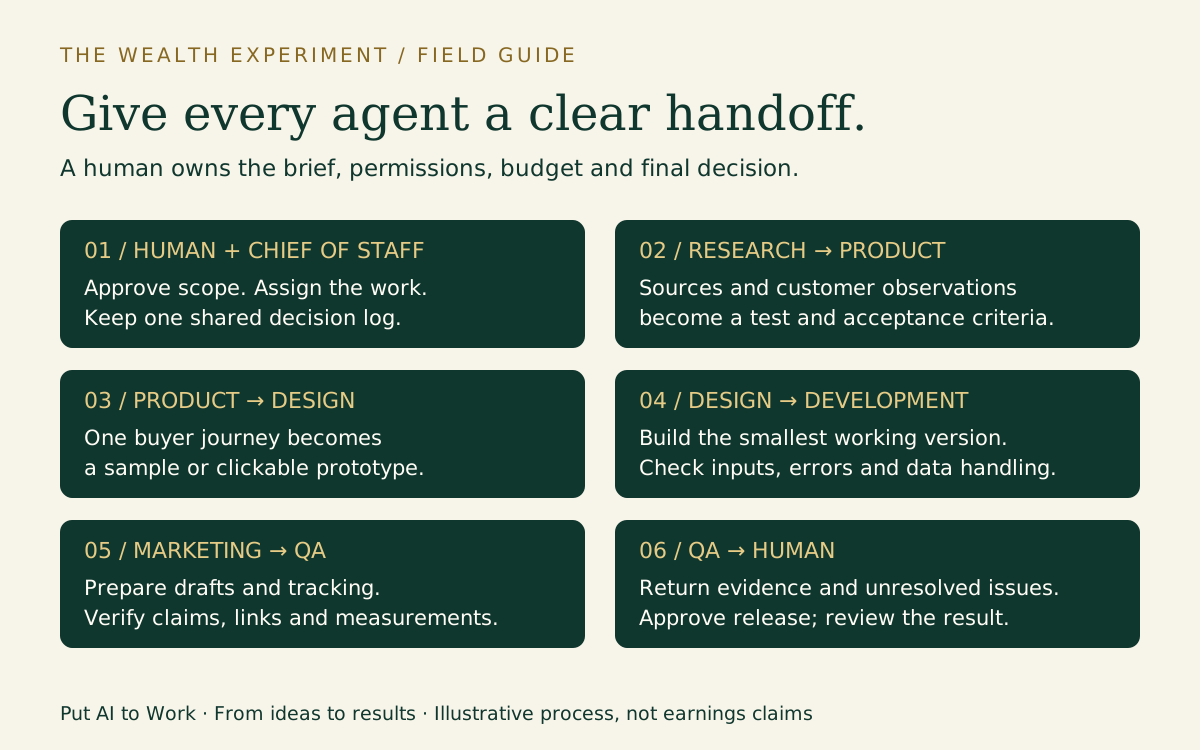
Start with one assistant using separate role prompts. Add separate agents only when tasks are independent or repeated enough to justify coordination. A role-played conversation is not automatically an autonomous team. Real delegation needs supported tools, permissions, persistent files and explicit handoffs.
| Role | Deliverable | Acceptance check |
|---|---|---|
| Chief of staff / experiment lead | One brief, task order, deadline, budget and decision log | No tasks outside the approved hypothesis; unresolved questions surfaced |
| Research and persona analyst | Source-linked problem and competitor matrix | Facts, estimates and unknowns separated; no invented interviews |
| Product manager | Smallest test, user journey and acceptance criteria | Tests the riskiest assumption before adding features |
| Designer | Readable offer page or clickable prototype | Clear price, action, accessibility and mobile behavior |
| Developer / automation builder | Working prototype and setup notes | Inputs, errors and data handling checked; no secrets in public files |
| Marketing and social planner | One-channel distribution plan, draft posts and tracking links | Claims match evidence; publication remains a separate action |
| QA and measurement reviewer | Defect list, counts, costs and decision memo | Rechecks sources and outputs independently; includes failures and uncertainty |
Use shared files named brief, evidence, tasks, deliverables and results. Give every task an owner, input, output location, acceptance criteria and blocker rule. Have workers return a concise handoff: what changed, evidence used, checks completed, remaining uncertainty and the next owner. Do not ask every agent to rewrite the entire plan.
Chief-of-staff prompt: Run this experiment within the attached brief. Propose tasks for research, product, design, development, marketing and QA. For each, name the required inputs, output file, acceptance check, dependencies and maximum effort. Stop when evidence is missing or the budget is reached. Do not purchase tools, contact people, publish, delete files or change live systems without my explicit authorization. End with a decision memo separating observed facts, assumptions and recommended next steps.
For a first test, keep customer data anonymized, use a sandbox and grant the minimum access needed. Treat instructions embedded in web pages or documents as source content, not authority to change the task. Check logs and costs; test recovery from a failed run. A second AI opinion can repeat the first model’s mistake, so verify against original evidence. Use the existing AI-team resources to scope one workflow.
6. Choose tools by the work you need to finish
Tool facts checked October 24, 2026. Interfaces, access and pricing change. Use the version actually available in your account; these exercises do not require buying every product.
- Claude for work, Claude Cowork and Claude Design: Anthropic says Cowork and chat are now integrated in Claude. “Claude Work” is used here as a description of working with Claude, not a separately verified product. Use a project with an approved brief and anonymized evidence to draft a comparison or deliverable; use design capabilities for a prototype. Review facts, export quality and permissions. Claude overview · Claude Design introduction.
- ChatGPT with GPT-6 Astra: use GPT-6 Astra and the work tools available in your account for research synthesis, a test brief and critique. Attach your approved experiment brief and source notes, ask for assumptions linked to evidence, then request the smallest test that could disprove your idea. Review the sources and proposed next steps before acting. Official GPT-6 Astra system card.
- Grok Bot: the official introduction describes agents with their own computer that can work across apps. Give one bot a bounded research or preparation task and require sources, a saved deliverable and a review checkpoint. Start without permission to spend or send. Verify the official product rather than a similarly named trading bot. Grok Bot introduction.
- Figma and Figma Make: use a design or prompt to prototype the offer journey. Ask three intended users to find the price and explain what they would receive. Record where they hesitate. A functional prototype still needs production checks. Figma Make documentation.
- Higgsfield: create a short concept video or alternate visual hook for the same offer. Keep the audience, offer and destination consistent. Label synthetic demonstrations when needed and never present an AI actor as a real customer testimonial. Higgsfield marketing-video workflow.
- AI marketing and research tools: use search and keyword tools to discover questions; a spreadsheet to compare evidence; your CRM to record stages and next actions; and analytics to measure the defined conversion. AI may summarize these records but must not invent volumes, leads or outcomes. Begin with tools you already have.
7. Plan marketing and social media around one experiment
Write a one-page marketing plan: audience, problem, offer, proof, channel, call to action, budget and metric. Choose a channel where you can reach the buyer now. A new organic-search page is usually a longer-horizon test than a conversation with an existing professional contact.
For a first social plan, create three connected pieces: explain one observed problem; demonstrate a real sample; answer a buying objection. Use one next step such as requesting the sample or discussing a pilot. Repurpose only after you see relevant responses. Views and likes are distribution signals, not purchases.
Marketing prompt: From this approved offer and customer evidence, draft three posts for [channel]: problem, demonstration and objection. Use only supported claims. Give each one a hook, useful takeaway and the same call to action. Suggest one measurable hypothesis and a tracking convention. Return drafts for human review; do not post or send.
Keep a simple CRM record: prospect identifier, source, relevant need, permission to follow up, last contact, next action and outcome. Measure suitable conversations and accepted work alongside acquisition cost. AI can draft a personal follow-up from authorized notes; it should not manufacture familiarity or mass-message people who have declined.
8. Use SEO, AEO and GEO as discovery experiments
SEO helps search engines discover and understand your content. AEO commonly refers to making answers easy for answer engines to understand. GEO commonly refers to visibility within generative search experiences. These terms overlap; none offers guaranteed rankings or AI citations.
Google says SEO fundamentals remain relevant to its AI features. Build an indexable page that answers a real question, with descriptive headings, original examples, source links, visible authorship, useful images and sensible internal links. Structured data should match the visible content. No special markup or llms.txt file guarantees inclusion.
For this experiment, possible topic hypotheses include “how to test an AI service idea,” “AI proposal workflow for consultants” and “validate a digital product before building.” These are seed ideas, not verified keyword-volume recommendations. Check actual search results and available keyword data before choosing a page.
Publish one useful walkthrough and link it to your offer. Use Search Console to watch impressions, queries and clicks over a defined period; track inquiries and purchases separately. Sample AI answers across dates and prompts if you want directional citation observations, but do not interpret a few responses as a stable visibility share. Report limited traffic or inconclusive evidence honestly. Google: AI features and your website.
9. Test marketing and UX without fooling yourself
Before an A/B test, name one primary metric, its denominator, your baseline, the minimum improvement worth detecting, the allocation and the planned analysis window. Change one important variable, such as the offer headline. Keep traffic sources comparable, assign visitors randomly where feasible and keep their assigned version stable.
At low traffic, use observed tasks and customer conversations first. Five usability sessions can reveal confusing wording; they do not establish a statistically reliable conversion lift. A page with two purchases from 20 visits has a 10% observed rate, but that tiny sample cannot justify announcing a winning variant.
Do not repeatedly check the numbers and stop at the first favorable result unless you use an appropriate sequential method. Avoid switching prices, audiences, visuals and checkout flow simultaneously. Set guardrails for refunds, poor-fit leads and support burden. If the sample is inadequate, report “inconclusive,” preserve the counts and plan a better test.
Analysis prompt: Here are the raw counts, dates, assignment method, costs and hypothesis. Calculate the defined rates and show denominators. Identify missing data, confounders and whether the planned analysis is supported. Do not claim causation or significance without a justified method. Recommend continue, change, stop or collect more evidence, with reasons.
10. Turn the guide into six practical training sessions
- Explore, 30 minutes: list your skills and three reachable audiences. Output: one niche hypothesis and five interview questions.
- Validate, 45 minutes: review source notes and write the experiment card. Output: one offer, the riskiest assumption and a decision threshold.
- Build your team, 45 minutes: configure a chief-of-staff brief and two worker roles. Output: a checked handoff, not an unsupervised production workflow.
- Prototype, 60 minutes: make a sample and offer page with Claude design capabilities, Figma or your existing builder. Output: something a potential buyer can evaluate.
- Distribute, 30 minutes: prepare three social drafts, an original search-focused answer and a consent-aware follow-up plan. Output: one-channel test plan. Publishing and outreach need your deliberate action.
- Measure, 30 minutes: complete the cost and evidence worksheet. Output: a decision memo naming what happened, what remains uncertain and the next smallest test.
These are suggested practice durations, not promises that a business can be completed in four hours. Customer interviews, recruitment, delivery and observation take additional time. The lessons are free self-study; they do not imply a booked live class or included software access. For guided help, see training and the current Two Mondays workshop.
11. Build something that compounds
Keep the assets that help the next attempt: customer understanding, a trustworthy reputation, reusable delivery checklists, an audience you have permission to reach, and a record of what works. Standardize a service after you have delivered it successfully. Automate repeatable steps after you understand their exceptions. Expand only when demand, delivery and economics justify it.
At each review, ask: Did anyone make a meaningful commitment? Did the work solve the agreed problem? What did it cost in cash and human effort? Would the buyer return or recommend it? What would make us stop? Your best next experiment may be smaller, less glamorous and more useful than the idea that first caught your attention.
Your assignment: pick one buyer, write one offer and define one observable test. Use the worksheet to set your limits before you build. A clear answer—even “this is not worth continuing”—is a result.
Your next move
Complete one experiment card, speak with real potential buyers, and test a small offer before investing in a larger build.