In this article
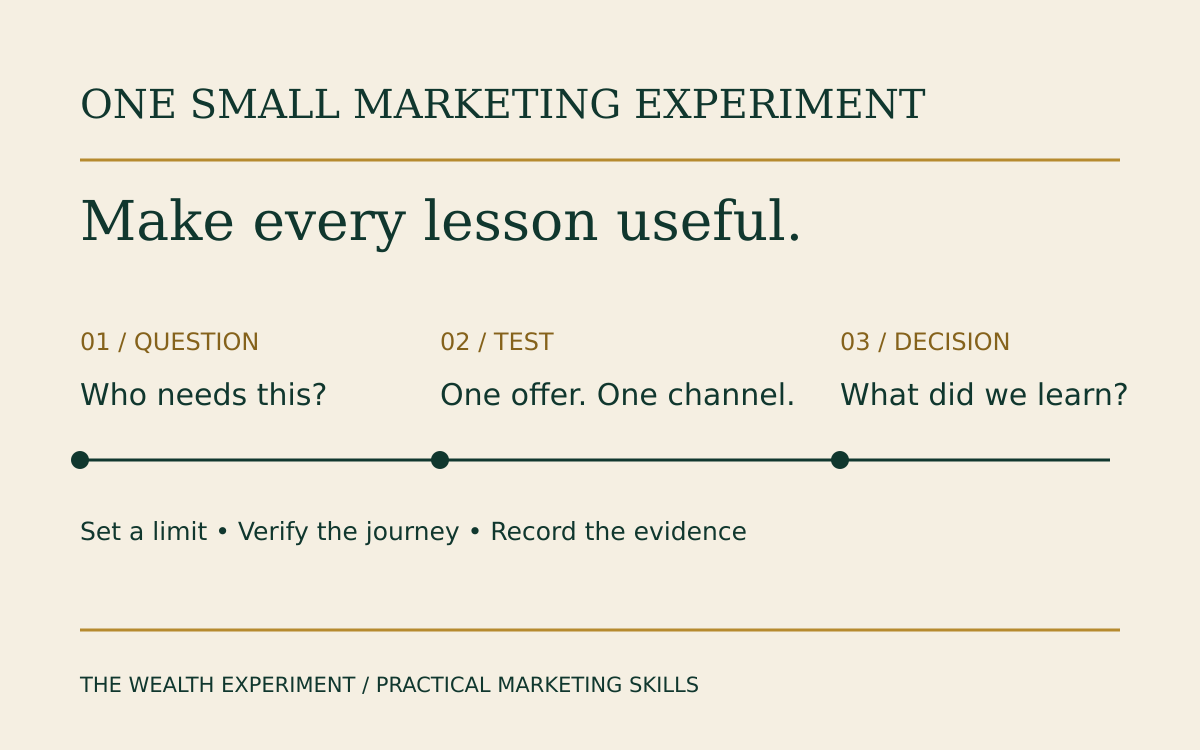
You can learn a great deal about digital marketing by helping one real offer find its first interested buyers. A small experiment gives every lesson a purpose: discover what people want, explain your offer clearly, make the next step easy, and see what happens.
The aim is to build a useful skill and a record of evidence. A first experiment is not a promise of income, and a small ad budget cannot answer every question. Start with a loss limit you can comfortably afford, including a limit on your time.
Choose an offer small enough to explain and deliver
Pick one customer and one result: a local plant-care visit, a spreadsheet cleanup for a small business, a handmade gift, or a focused service you already know how to provide. If you cannot explain who benefits and what they receive, advertising adds another variable before the offer is clear.
Write: “For [person in a specific situation], this offer helps with [problem] by providing [deliverable] for [price].” Then list the costs and hours required to deliver it. For an affiliate project, work with your expected commission and network terms; the merchant’s total selling price is not your revenue.
Your first exercise: ask three potential customers how they currently solve the problem. Record their words, alternatives, and objections. Three conversations can improve a hypothesis; they do not establish market demand.
Listen for the searches behind the problem
Make three columns: the problem, possible solutions, and searches that suggest someone wants help now. For a hypothetical plant-care service, “why are my leaves yellow” is different from “vacation plant watering service.” The first could inspire a helpful article; the second may fit a service page.
Check the search results and local context before deciding. Google Keyword Planner can help estimate demand and advertising costs, but its competition metric describes advertising competition. It is not an organic ranking difficulty score or a forecast of your profit.
Search Console helps you see how your own site appears in Google Search. Analytics helps you investigate what visitors do after arriving. They answer different parts of the journey, and their totals do not have to match exactly.
Run a no-spend rehearsal
Create one clear offer page with scope, price or a transparent quoting process, evidence you can substantiate, and one next action. Show it to a few relevant people through a channel where sharing is welcome. Avoid mass unsolicited messages or joining a community only to advertise.
Ask a reviewer to find the offer, explain it, and take the next step. Check the form, confirmation, follow-up, and mobile experience. Record visits and inquiries if you have a working, appropriately configured measurement setup. Label any missing data instead of filling gaps with guesses.
This rehearsal can uncover confusing copy and broken flows. It does not prove that strangers arriving from an ad will behave like people who already know you.
Model a paid experiment before funding it
Here is an illustrative service experiment, not a suggested minimum spend or a forecast. Assume a $150 advertising limit, $3 average cost per click, a 10% click-to-inquiry rate, and a 20% inquiry-to-customer rate.
- $150 ÷ $3 = 50 clicks.
- 50 × 10% = five inquiries.
- Five × 20% = one expected customer.
- Media cost per expected customer = $150.
If the service sells for $300 and variable delivery costs are $100, that leaves $200 contribution before acquisition. After $150 in media, $50 remains before your other costs. A lower conversion rate or higher click cost could erase it. Actual outcomes are whole customers and may be zero; the arithmetic is a planning scenario, not a reliable prediction from a small sample.
Change one assumption at a time. What if clicks cost $6? What if only one in ten inquiries buys? If the plausible range is unaffordable, refine the offer or choose another way to reach customers before buying traffic.
Give each week a concrete output
- Week one: customer language. Produce an offer brief and ten search hypotheses.
- Week two: a working journey. Publish the page, rehearse the action, and verify measurement.
- Week three: one distribution test. Use an appropriate organic channel or a deliberately limited paid test. Record what changed and what you spent.
- Week four: a decision. Review inquiry quality, delivery effort, customer feedback, and economics. Continue, revise, or stop with a written reason.
You can complete the research, page, and campaign-drafting exercises without launching ads. If traffic is too limited to assess conversion, say so. An inconclusive result is useful when it prevents an unjustified claim.
Keep an experiment notebook
Use these fields: question; audience; offer; channel; hypothesis; spend limit; time limit; tracking check; observed visits; inquiries; qualified inquiries; customers; revenue collected; delivery cost; and next decision. Use a dash for unknown values and distinguish projections from observations.
Before the test, write a practical stopping condition, such as a broken form, an exceeded loss limit, or persistent irrelevant traffic. Schedule a review that allows for your buying cycle. Resist changing the audience, offer, creative, and landing page together if you want to understand what made a difference.
Let AI help with preparation and reflection
Try this prompt: “Here is my offer and anonymized customer feedback. Suggest three distinct messages using only supported facts. For each, explain the buyer concern, likely objection, and evidence still needed. Do not create testimonials or promise earnings.”
After the experiment, ask AI for alternative explanations of the result. Keep the real figures and your decision log as the source of truth. You remain responsible for claims, spending, and customer experience.
Keep the next move small
Use the offer builder to clarify your starting point, explore the launch guides and worksheets, or visit Work With Me for help designing a focused experiment. Start with one question you can reasonably investigate this week.
Official learning resources
- Google Ads: Keyword Planner forecasts and historical metrics
- Google: using Search Console and Analytics together
- Google Skillshop: Search and Measurement training
- Google Analytics Academy
Platform references reviewed October 14, 2026. Exercises and numerical scenarios are original teaching examples, not campaign results or vendor guarantees.
Your next move
Choose one offer and write the customer question your first experiment should answer. Set a time limit before choosing a channel or spending money.