In this article
Maybe you have a skill people ask you about. Maybe you keep saving ideas for a class, a useful video series or a little business you could build around what you know. You can take that curiosity seriously without turning your life upside down.
The SBA’s recognition of creator businesses is encouraging. For an early experiment, the question is simple: can your knowledge help a specific person enough that they choose a clear next step?
The news, in plain English
The SBA’s October 15, 2026 guidance explains how qualifying audiovisual creator businesses can identify a suitable classification within NAICS 5121. It is a clarification for existing programs, not a new grant or a promise of financing.
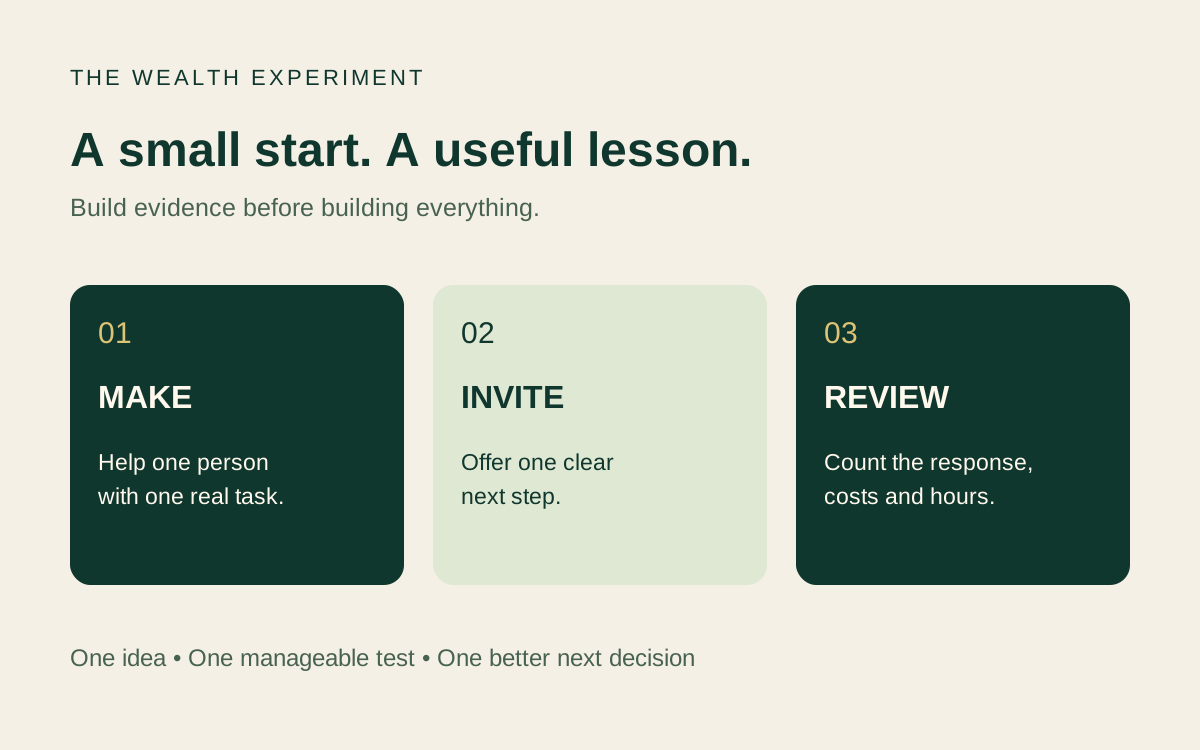
My practical takeaway is to build evidence before adding expense. You can learn whether an offer is useful with a modest project and careful notes. You do not need a large audience, a new studio or a stack of subscriptions to begin that learning.
Pick a skill, a person and a small result
Write this sentence: “I help [person] complete [task] by providing [deliverable].” Make the result small enough that you can explain it clearly and know when you have delivered it.
For example, a fictional creator who teaches simple technology could offer to help a solo service business turn its scattered enquiry notes into a usable follow-up checklist. The content might demonstrate the checklist. The paid service would help the business adapt it. This is a proposed experiment, not a case study or a claim that customers will buy.
Run a two-week test you can afford
- Days 1–2: listen. Talk with a few people who fit your audience. Ask how they handle the task now, where it gets difficult and what they have already tried.
- Days 3–4: make a sample. Create a small demonstration with information you have permission to use. Explain exactly who it helps.
- Days 5–7: publish a clear invitation. Share the sample where relevant people can find it. State the scope, price if charging, delivery timing and next step.
- Days 8–12: learn from real responses. Answer questions, record objections and deliver any accepted work within the agreed scope. If nobody responds, note that too.
- Days 13–14: decide. Review useful feedback, completed actions, costs and hours. Choose to continue, change the offer or pause.
Set your own time and spending limits before starting. The two-week window is a planning suggestion, not a deadline for becoming profitable.
Keep an evidence ladder
| Observed signal | Reasonable interpretation |
|---|---|
| A like or encouraging comment | The content got a reaction |
| A relevant person asks about scope or price | There is interest worth understanding |
| A customer pays and receives the work | You completed a transaction |
| Several deliveries produce a positive contribution after costs | You have stronger evidence to examine, including the hours involved |
A small sample can reveal a useful problem without proving repeatable demand. Record what happened accurately. If distribution was too limited to evaluate the idea, mark the result inconclusive.
Count the effort behind the income
Here is an illustrative calculation: one $150 delivery minus $20 of direct costs leaves $130 before taxes and other overhead. If research, sales, delivery and follow-up took five hours, that is $26 per hour before those remaining costs. The example is arithmetic, not a suggested price or an earnings forecast.
Include the time you spent making content, fixing mistakes and learning tools. Keep money received separate from enquiries and unpaid invoices. These notes help you decide whether the work fits your life as well as whether someone will buy it.
Let AI help with a specific task
Use your own interview notes to draft an outline, organize recurring questions or check whether an offer leaves details unexplained. Ask the tool to flag missing information. Review the result before publishing. Do not let it invent demand, customer quotes or your experience.
Using only these notes, identify the repeated problem, propose one small deliverable and list the assumptions I still need to test. Keep observed facts separate from suggestions. Do not invent customer responses or revenue.
Choose your next manageable step
Use the First Experiment Planner to write your audience, offer, time limit and review decision. If you need help understanding business classification or planning, bring your actual activity and records to an SBA resource partner.
You are allowed to build slowly. A useful lesson, an honest result and a clearer next decision are worthwhile progress.
Sources and editorial context
Reviewed November 3, 2026. Inspired by Julian Cabus’s reporting in Venture Tech Chronicle and checked against the SBA’s October 15 announcement. The exercises and examples here are our editorial recommendations, not SBA requirements or reported business results.
Find SBA local assistance. Program eligibility and business classification depend on your circumstances.