An assistant might use your comparison to help a buyer choose without sending that person through your link. You can influence the decision while earning nothing from it. That is a plausible business risk to test, not evidence that every affiliate program is about to stop working.
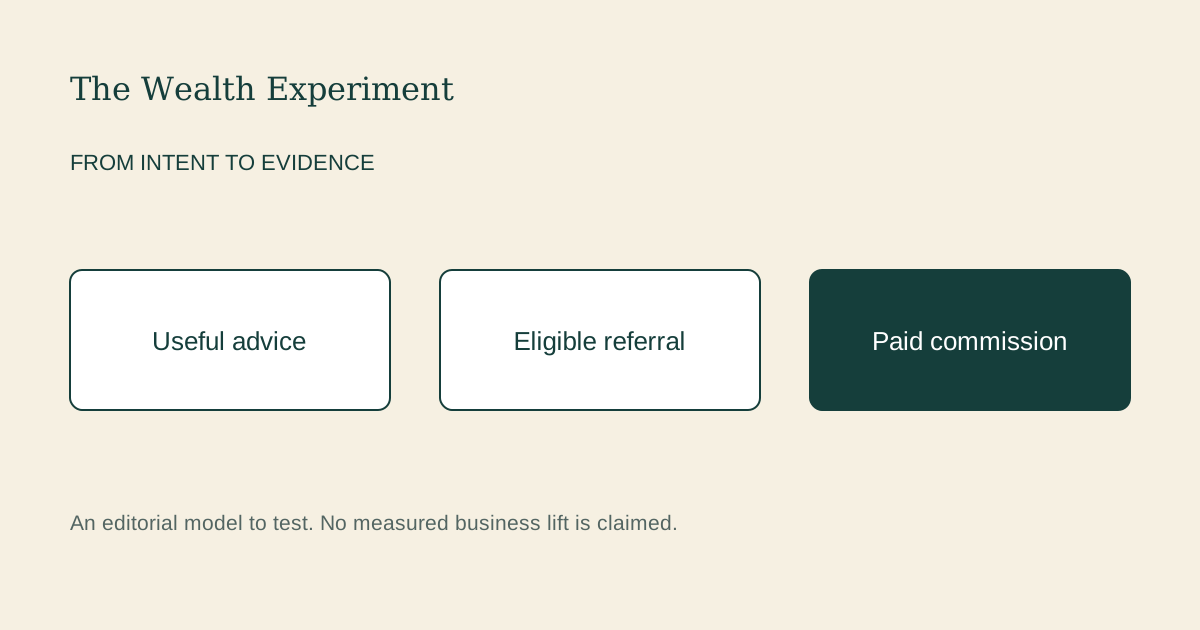
Separate four events
- Your work is found or cited.
- A person takes a useful next step.
- An eligible referral is recorded under the program’s rules.
- The merchant approves a commission after any exclusions or reversals.
None guarantees the next. A citation is not a tracked click. A tracked click is not an approved purchase. A commission displayed as pending is not settled income. Preserve these distinctions in a simple experiment log.
What becomes harder?
Our forecast is that generic comparison pages face more pressure when an assistant can produce a shortlist immediately. Cross-device research, copied links, in-assistant checkout and lost referral parameters can further complicate attribution. The size of that effect depends on the program and customer journey; we do not have verified portfolio revenue evidence for it.
Do not assume a universal cookie window, commission rule or AI-agent policy. Read your specific merchant agreement. Ask whether its supported referral methods cover assistant-mediated purchases, approved feeds or codes, and what evidence resolves a missing commission. A new API does not create a commercial attribution agreement.
Build something worth returning to
Choose a narrow buyer problem you can actually investigate. Publish your method, product version, date, limitations and evidence of real testing where you have it. A useful compatibility worksheet, original comparison, maintained price source or decision tool can give readers a reason to visit beyond a recycled list.
Label untested products as untested. Make commercial relationships clear near recommendations. Keep unsuitable options and reasons not to buy in the analysis. A trustworthy recommendation has value even when the highest-paying product is not the right fit.
A small attribution experiment
Start with one existing approved program and one buyer task. Verify the permitted link format and where it can be used. Record the source page, disclosure, destination, program terms-check date and expected reporting delay. Use a program-approved test facility where available; do not generate self-purchases or artificial conversions to make the report move.
Track page visitors, useful-tool completions, recorded outbound clicks, program-reported referrals, approved orders, reversals, earned commission and hours spent. Keep unexplained gaps visible. A reader’s optional report of finding you through AI is context, not proof of incrementality.
At review, compare net approved commission after direct costs and maintenance effort. Investigate discrepancies between your click log and the program report before buying more traffic. A small sample may justify fixing tracking or improving the page; it rarely justifies a confident earnings forecast.
Could feeds or APIs become a revenue stream?
Possibly, where there is an actual buyer for reliable proprietary information or a useful service. Licensing data, selling a tool, negotiating supported referral integrations or delivering a service are separate business models with costs and terms. Publishing an endpoint alone does not create demand or payment.
The web remains the place you can maintain evidence, host tools and build a direct relationship. The surface people use to reach it may change. Build a useful asset, establish a permitted route to revenue, and measure both.
Use the first-links experiment and Affiliate Lab to scope your next test. The research brief explains why high-intent AI referrals should not be confused with incremental demand. This article is a business experiment framework, not an income claim or a statement of any particular program’s current terms.
Continue with the companion guides
- AI shopping, experiment bias, and the difference between retention and loyalty
- The web after AI agents: build for decisions and completed work
- UX for AI agents: design APIs that deliver a result people can trust
Published November 7, 2026. Recommendations and scenarios are editorial proposals, not measured portfolio or client outcomes.
For a program-by-program audit, read AffiliateMarketingCoach’s AI-agent attribution playbook.