In this article
When you are building something small, every unfinished purchase can feel personal. Someone reached the checkout, saw what you made, and left. It is tempting to redesign the offer or lower the price immediately.
Try a smaller question first: can you make it easier for an interested person to return and make an informed decision?
This is a proposed experiment, not a report of results from Wealth Experiment or its projects. It was prompted by MailerLite’s article on abandoned-cart emails. The examples and experiment plan here are original.
Make sure this is an experiment you can run
You need an offer you sell directly, a checkout system that records meaningful events, and an eligible contact you are permitted to email. A product-page view is not an abandoned checkout. If you operate an affiliate site and the purchase happens at another merchant, you generally cannot observe or recover that merchant’s checkout unless a specific authorized integration provides that capability.
If you have no identifiable eligible abandoners, do a checkout usability review instead. Ask willing testers to explain where they become uncertain, inspect the mobile flow, and fix missing information. Do not purchase more software simply to create the appearance of an experiment.
Write a hypothesis you can disprove
For eligible people who start checkout for [offer] and do not buy, one clear return link plus an answer to [verified common question] may increase completed paid orders within [chosen window], without making contribution or customer experience worse.
Choose the observation window before starting. Keep a record of the offer, price, traffic source, existing email experience, and any other promotions. Write down what would lead you to keep, revise, or stop the approach. “We sent emails” is an activity measure, not the outcome.
Two original messages for a small digital offer
These drafts assume you can provide a secure, working return link and that the recipient qualifies for the message. Replace every placeholder. Do not imply a seat is held or a file is ready unless your system really supports that promise.
A simple reminder
Subject: Continue exploring [offer name]
Preview: What is included, and a way back if you need it.
You started checking out [offer name]. It includes [verified deliverables] for [actual price and payment terms]. If you would like to continue, you can review the details and complete checkout below.
If something was unclear, reply with your question. No action is needed if your plans have changed.
Button: Review the offer and checkout
A useful answer
Subject: Do you need [prerequisite] for [offer]?
Preview: A clear answer before you decide.
A question worth answering before you buy: [actual common question]. The answer is [verified requirement or limitation]. The offer covers [scope]; it does not include [important exclusion].
If that fits what you need, you can return below. If you are unsure, reply and ask.
Button: Check the fit and return
For a workshop, that question might concern required experience, schedule, or software costs. For a downloadable resource, it might concern file format, included templates, or access. Use the actual offer terms. A recovery message should not introduce a more generous promise than the sales page.
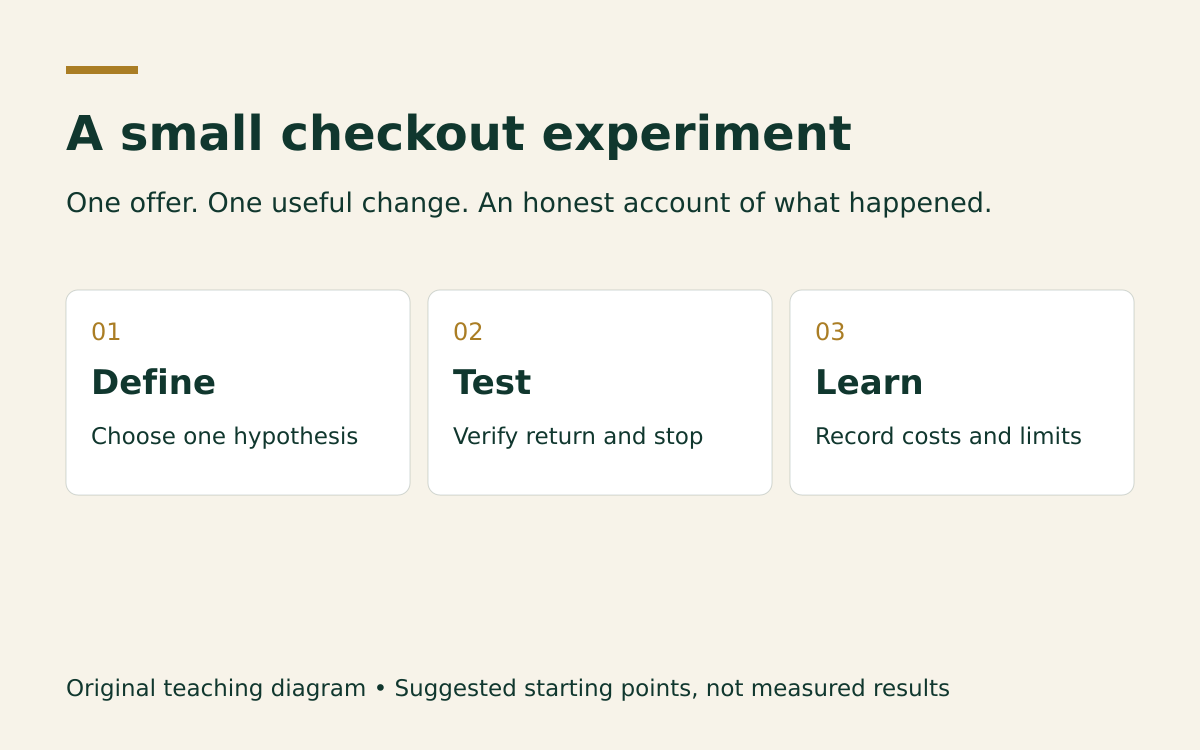
Keep the first build small
- Review the checkout on a phone and repair obvious problems.
- Document the event that starts recovery and how the customer becomes identifiable.
- Choose one approved message and a delay to test, such as approximately one hour.
- Verify that completed purchases and requests to stop suppress future messages.
- Check your own controlled test records, then observe real eligible traffic.
- Review the result at the planned time without inventing a conclusion if volume is low.
Add the second message only if it has a clear job. Keep a limit on repeat entry and coordinate with any recovery already running. A valid unsubscribe and an owned reply inbox belong in the launch check, not on a someday list.
Ask the platform the right questions
Can it recover a checkout for a first-time buyer? Can it identify someone who added to cart without starting checkout? Does it require a marketing subscription? What happens after a purchase from another device? How does the return link expire?
For example, MailerLite documents Shopify-specific eligibility limits for recognized shoppers and returning purchasers, alongside subscription requirements. Read the integration documentation rather than assuming all abandoned sessions can receive an email. A digital-product or workshop checkout may use a completely different integration.
Use a tiny scorecard with honest denominators
Record the start and end dates, eligible unique customers, messages delivered, paid orders within the window, gross sales, discounts, refunds, variable delivery and payment costs, tool costs, and setup time. Keep unknowns visible. Do not mix every website visit into the recovery denominator.
Illustrative only: if 20 eligible customers receive the new experience and two purchase, that is a 10% observed purchase rate for that small group. It does not establish that the emails caused two sales, or predict a 10% rate next month. One person might have returned anyway.
If volume permits, randomly assign eligible customers to the current experience or the new reminder, hold the offer constant, and compare the same purchase window. If it does not, describe the result as a pilot observation and use replies and usability findings to choose the next test. An inconclusive result is still useful when it prevents a false claim.
Include your own time in the decision
A small automation has setup, troubleshooting, and maintenance costs. Record those alongside the money. You may discover that one clearer sentence on the checkout page solves a recurring question more cheaply than a complicated email sequence.
Use the workflow run log to record the work involved and the first-experiment planner to narrow the next test. If you share the process publicly, publish aggregate observations and anonymized lessons, not customer addresses or private checkout links.
A useful build-in-public update
I tested [specific change] for [offer]. During [window], [count] customers were eligible and [count] completed paid orders. I spent [time] and [cost]. This does not yet prove incremental sales because [limitation]. The clearest observation was [verified finding]. My next change is [one action].
You do not need a dramatic result to have something worth sharing. A precise account of what worked, what failed, and what remains unknown can help someone else make a better decision.
Published October 16, 2026. This is an experiment design with illustrative examples; no live recovery automation or measured recovery results are claimed.
Your next move
Choose one offer you sell directly. Write one useful reminder, verify the return and stop conditions, and log costs and observations before judging the result.