AI & changing work
Will someone pay for your AI skill? Run this 14-day experiment
A list of emerging AI jobs can spark an idea. A small experiment can help you decide what to do with it. Test one useful service with a clear deliverable, a limited time budget, and a real buying decision.
In this guide
- The useful starting point
- Turn the job title into a customer problem
- Days 1–3: make the offer concrete
- Your four-step starting plan
- Days 4–7: listen for the problem before presenting the solution
- Days 8–14: deliver, measure, and make a decision
- Keep a scorecard that helps you decide
- Sources and further reading
The useful starting point
Choose one customer problem, define a small service, and create a useful sample.
Turn the job title into a customer problem
Indeed’s 2024 article prompted this practical look at changing work.
Someone interested in AI instruction might help a small team learn one recurring task. A careful editor might review a set of AI-assisted service pages against approved facts. An operations specialist might organize the documents a customer-service assistant needs. Start with work you understand well enough to recognize a useful result.
Choose one audience you can reach. Then write a simple hypothesis: 'Independent consultants who struggle to send timely meeting recaps will consider paying for help creating a reusable recap process.' That sentence identifies the customer, the problem, and the thing you need to learn. It also keeps you from spending two weeks building a course nobody has asked for.
Days 1–3: make the offer concrete
Describe a deliverable that fits inside your available time. For the meeting-recap idea, it could include a reusable template, a tested instruction set, a quality checklist, and a short walkthrough. Set boundaries: the client reviews final messages; ongoing inbox management is a separate job.
Create a sample with information you have permission to use. Show the starting notes, the finished recap, and the checks that connect them. The sample should help someone understand what they would receive. You can make it useful without designing a logo, buying several subscriptions, or creating an elaborate sales funnel.
Choose a pilot price and a time limit before offering the service. Include preparation, delivery, revisions, and support in your estimate. Treat the price as a test for this scope, not as a claim about what other freelancers earn. You are trying to find a sustainable exchange of value.
Your four-step starting plan
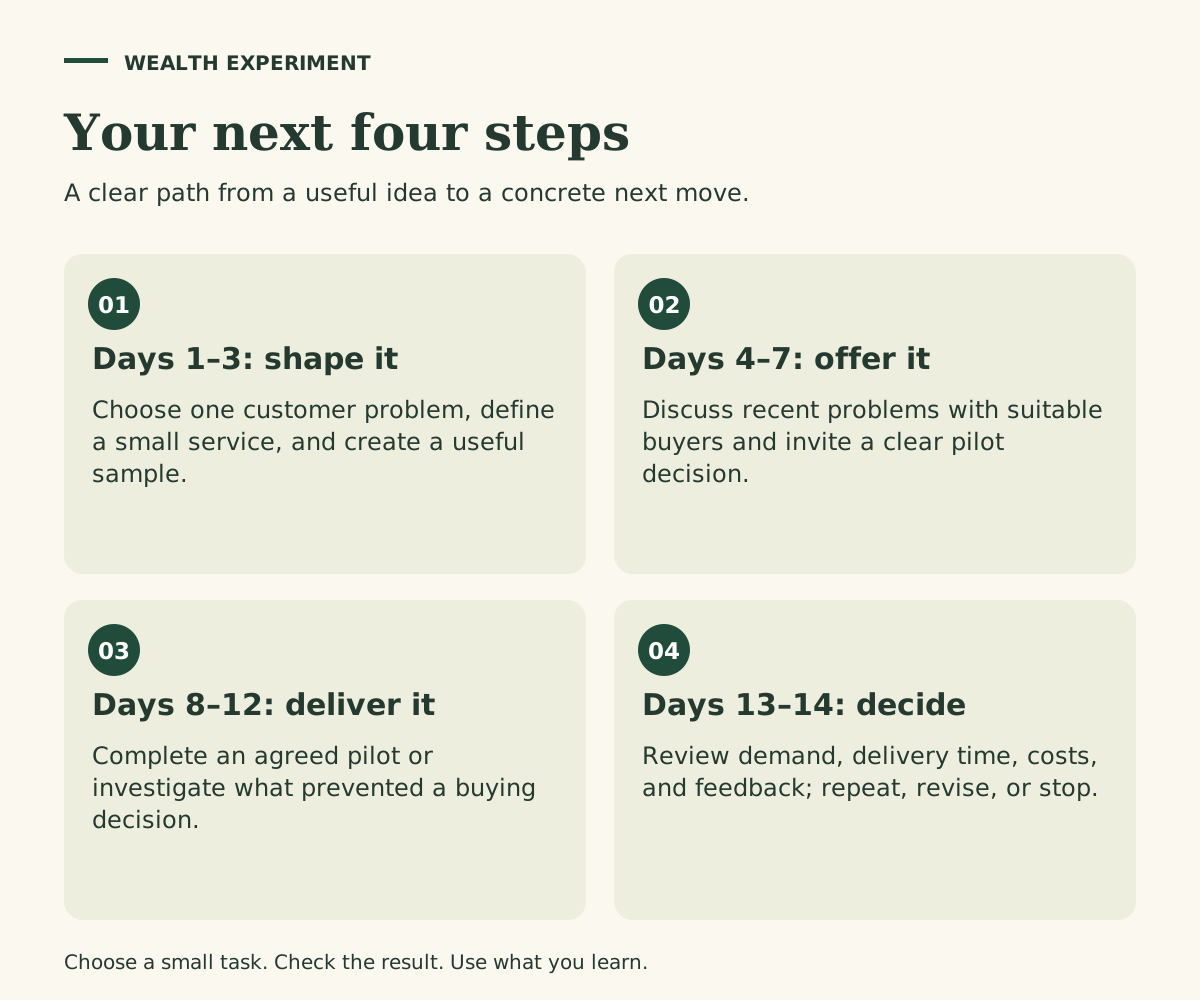
- Days 1–3: shape it
Choose one customer problem, define a small service, and create a useful sample.
- Days 4–7: offer it
Discuss recent problems with suitable buyers and invite a clear pilot decision.
- Days 8–12: deliver it
Complete an agreed pilot or investigate what prevented a buying decision.
- Days 13–14: decide
Review demand, delivery time, costs, and feedback; repeat, revise, or stop.
Days 4–7: listen for the problem before presenting the solution
Speak with a small number of people who fit the audience. Ask about the last time the task became frustrating, what they did, and how they handle it now. A concrete recent example tells you more than an enthusiastic answer to 'Would you use AI for this?'
When the problem and timing fit, show the sample and offer the defined pilot. Give the person a clear next step and room to decline. Record the difference between someone liking the idea, asking for details, requesting a proposal, and committing to a paid project. Those actions mean different things.
If people describe another problem, capture it without immediately expanding the service. You may discover that preparing the recap is easy but gathering decisions is difficult. That insight could change the next version of the offer more than another round of prompt improvements.
Days 8–14: deliver, measure, and make a decision
If a buyer commits, confirm the scope, inputs, delivery date, and review process in writing. Complete the pilot and record the time spent on each part. Ask the buyer to use the result in their normal work and describe what was helpful, what was confusing, and what still needs effort.
If nobody buys, examine the evidence you actually have. A few unanswered messages do not establish that nobody wants the service. You may need a better way to reach the audience. Repeated conversations that reveal no meaningful problem are a different signal. Change the part the evidence points to.
At the end, choose one of three actions: repeat the same offer, change one assumption, or stop this version. Write down the reason. For example, you might keep the recap service because a buyer used it, while narrowing revisions because delivery took too long. Or you might move to another task because the conversations showed little urgency.
Keep a scorecard that helps you decide
Track qualified conversations, specific problem examples, proposals, paid commitments, cash received, direct costs, and total hours. Keep unpaid practice time visible. Revenue alone does not tell you whether the work fits your schedule or leaves enough room to deliver well.
Our recommendation: finish this small cycle before adding a second offer. You will have a more useful starting point for your next decision—a tested scope, a sample, and evidence from real conversations. For guided help shaping and building your first offer, explore Two Mondays to a Side Hustle and the current workshop details.
Sources and further reading
Sources checked November 11, 2026. Review the linked publisher information for current details.
Put one idea to work
Get guided help turning an idea into a clear offer and a small project you can put in front of potential customers.
Explore Two Mondays to a Side Hustle →Explore more from Wealth ExperimentGet the Wealth Experiment field notes →Keep practicing
 Agent-friendly websites
Agent-Friendly Website: A Small Business Test You Can Run
Run a bounded agent-readiness experiment with a baseline, a short llms.txt file, a test log and an honest decision about what to do next.
November 11, 2026 · 8 min read AI browser workflows
Before you buy another tool, put your open Chrome tabs to work
Use ChatGPT to compare three software pages, check the full cost, and make one practical decision for your side hustle—with five illustrated steps and prompts to copy.
November 11, 2026 · 8 min read