AI & practical learning
Turn ten notes into one useful offer with AI
A simple second-brain exercise for turning your experience into a checklist, guide or service sample worth testing.
In this guide
- The useful starting point
- Your existing notes may contain a useful starting point
- Choose one person you could help
- Gather ten notes you have the right to use
- Ask AI to find repeated problems
- Turn one pattern into a sample
- Test usefulness before adding a bigger stack
- Build a habit that creates something useful
- Questions you might be asking
- Sources and further reading
The useful starting point
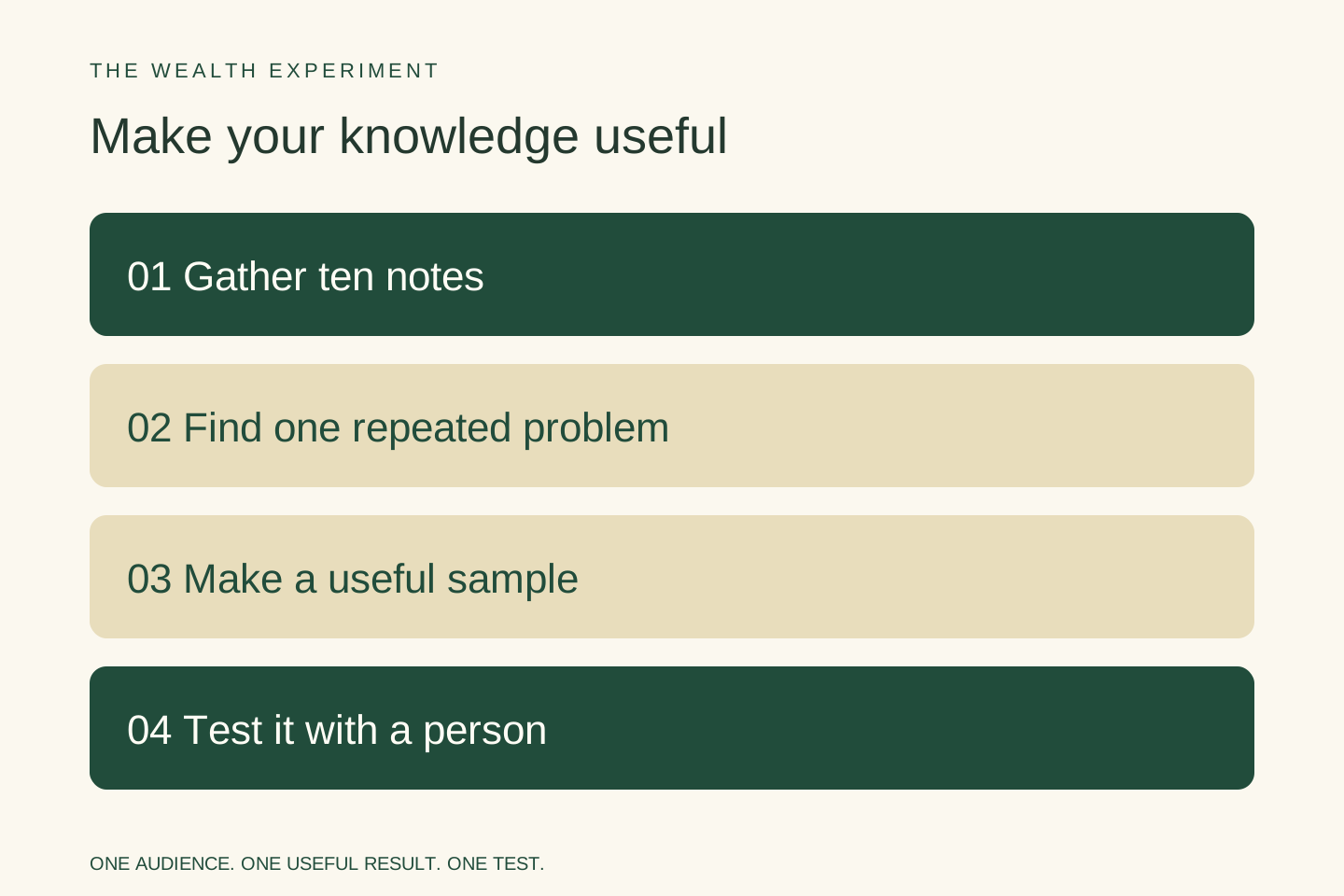
Choose one audience, gather ten permitted notes, find a repeated problem and create a small sample. Test whether someone can use it before building a larger knowledge system or paid product.
You may already have the raw material for a useful offer. It could be sitting in project notes, a checklist you made for yourself or an explanation you keep giving. This exercise helps you turn a small part of that knowledge into something another person can try.
Your existing notes may contain a useful starting point
Think about the information you return to repeatedly: checklists, explanations, project lessons and answers you have written more than once. A second brain is a way to organize that material so you can find and use it. It does not make the material valuable to a buyer automatically.
Karpathy’s LLM Wiki is one documented approach to using AI to maintain linked knowledge pages. For this exercise, borrow the idea of reusable knowledge and start much smaller: ten notes, one audience and one practical result.
Choose one person you could help
A broad archive invites broad, generic outputs. Instead, choose a situation you know. A photographer preparing a first client call might need a kickoff checklist. A new freelancer might need questions for a project brief. A community organizer might need an event preparation sheet.
These are illustrative ideas. Pick a situation you can explain from experience, then identify what the person needs to finish. You are looking for a useful result, not a way to sell every note you have collected.
Gather ten notes you have the right to use
Use your own material or information you have permission to reuse. Remove private client details. Keep original sources in one folder and working drafts in another. Add a source and date to each note so you can check it later.
Obsidian is one option for storing plain-text notes locally. An existing folder or notes app may be enough for the first exercise. If you connect an AI service, check which information leaves your device. Do not upload an entire client archive just to make a sample.
Ask AI to find repeated problems
Provide the selected notes to an approved assistant using a supported upload or connection. Ask it to identify repeated questions and propose one small deliverable. Require it to distinguish what the notes actually say from its own suggestions.
Review these ten notes for recurring problems faced by [audience]. Propose three small, useful deliverables. For each, identify the source notes, the task it helps someone complete and what is still unknown. Recommend one sample I can create this week. Do not invent customer demand, testimonials or earnings.Turn one pattern into a sample
Imagine your notes repeatedly show that kickoff calls stall because nobody has gathered the project goal, audience and approval owner. You could draft a one-page kickoff preparation sheet. Explain how to use it, include a fictional completed example and test whether another person understands it.
Keep the source references in your working copy. Check that each item earns its place and rewrite generic language into clear instructions. Do not present someone else’s checklist as your original product or sell a summary of private client information.
Test usefulness before adding a bigger stack
The viral Obsidian, Opus 5.5 and Jev combination names real technologies, but that does not mean you need all three. Jev is designed for structured decisions; adding a ranking layer is an implementation choice. The first question is whether your sample helps its intended reader.
Ask a potential user to complete the task using your sample. Watch where they hesitate, record what they change and ask what they would use again. Then decide whether to improve it, test a service around it or put it aside. Do not count an AI-generated product description as proof of demand.
Build a habit that creates something useful
Once a week, save one lesson from real work, update one draft and test one improvement. Your collection becomes useful through what you do with it. It does not need to run continuously to support a worthwhile project.
Use the First Experiment Planner to define the audience and test. If you want guided practice, request a free Two Mondays workshop place for November 2 and 9, 7–9 p.m. Eastern. Start with one sample you can explain and improve.
Questions you might be asking
Do I need Obsidian, Claude and Jev?
No. The basic exercise needs a small collection of permitted notes and an assistant you can use responsibly. Add tools only when a specific limitation justifies them.
Can I sell the first AI draft?
First check accuracy, reuse rights and whether the result helps the intended user. Clearly describe what the buyer receives and take responsibility for the final work.
Sources and further reading
- Andrej Karpathy: LLM Wiki
- Obsidian: how notes are stored
- Anthropic: Claude Opus 5.5
- TypeSafe: Jev and structured decisions
Sources checked October 23, 2026. Review the linked publisher information for current details.
Put one idea to work
Use the idea revival worksheet to turn a recurring interest into a small test with a clear decision.
Choose an idea worth testing →Explore more from Wealth ExperimentGet the Wealth Experiment field notes →Keep practicing
 Side-hustle experiments
Build a small AI team to test your first side hustle
Set up a small AI team, create a useful service sample and test demand in seven days. Includes role prompts, worked examples and a practical handoff template.
October 23, 2026 · 12 min read Side-hustle experiments
Will AI pay your bills? Start with a five-day side-hustle test.
Move from a viral income prediction to a useful sample, a customer conversation and a small offer you can evaluate.
October 23, 2026 · 5 min read