Side-hustle experiments
Build a small AI team to test your first side hustle
Set up a small AI team, create a useful service sample and test demand in seven days. Includes role prompts, worked examples and a practical handoff template.
In this guide
- How do you use a small AI team to test a real service?
- What a small AI team actually means
- Set up a place for the work before you start
- Choose a service where you can judge the output
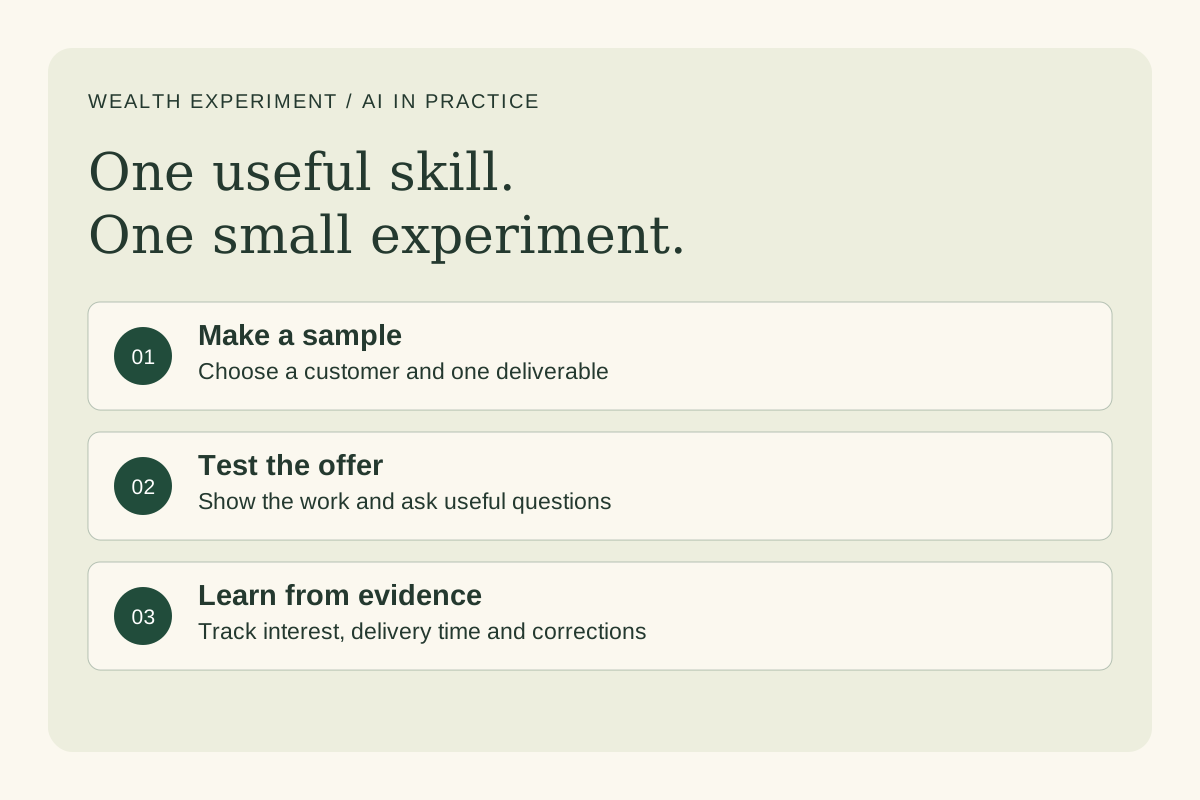
- Day one: choose one customer and one deliverable
- Day two: assign the AI a research job
- Day three: build a sample you can stand behind
- What the sample could actually look like
- Day four: ask for a separate review
- Give the reviewer a different assignment
- Day five: write an offer someone can understand
- Day six: put it in front of potential customers
- Day seven: decide what the evidence supports
- Keep enough memory to pick up tomorrow
- Check whether the service is practical to repeat
- Automate the part that has earned its place
- Build your first version with live help
- Sources and further reading
How do you use a small AI team to test a real service?
Choose a skill you can judge, assign planning, research, making and review, and create one useful sample. Keep the work in a shared record, show it to potential customers and use their responses to decide what to try next.
If you have a skill people already ask you for help with, AI can help you turn it into a small service to test. Give the AI specific jobs around the work: organize what you know, prepare a sample and check whether the offer is clear.
You can start with one assistant and a document. The “team” in this experiment is a set of responsibilities you assign in sequence. Creating separate agents can come later if the work justifies it.
For our example, imagine you have experience in marketing or design. You want to offer a one-page website clarity review for independent consultants. The customer receives three prioritized recommendations and an example rewrite of one confusing section.
This is a proposed experiment, not a reported business result. Its purpose is to discover whether you can deliver something useful and whether a customer wants it.
What a small AI team actually means
Think of the team as a few jobs around your idea. A researcher gathers evidence. A maker produces the first draft. A reviewer checks it. You decide what to offer and whether the work is good enough to show someone.
You can run those jobs in one AI assistant, one after another. That is a practical starting workflow. A connected agent can also choose and carry out actions with tools; a multi-agent setup assigns work to several agents. Anthropic distinguishes fixed workflows from agents that direct their own steps. [2]
For the website-review experiment, divide the responsibilities like this:
| Role | The question it answers | The output you keep |
|---|---|---|
| Planner | What are we making for which customer? | A one-sentence offer and a short task list |
| Researcher | What can we observe on the supplied page? | Evidence table with source details |
| Maker | What would the customer actually receive? | A one-page review and one example rewrite |
| Reviewer | Which recommendations need correction? | Issues, evidence and suggested fixes |
| You | Is this useful enough to test? | Your approved sample and next customer question |
The role labels are a way to organize work. They do not make the assistant a qualified expert, create access to a website, or set up an autonomous business. Your judgment and the customer's response still determine what is useful.
Set up a place for the work before you start
Use one assistant you already have and a folder or document you control. Create five sections: the offer, source material, current sample, review notes and customer responses. This keeps a useful idea from getting lost inside a long conversation.
Start with this original planning prompt:
Help me test one small service using a skill I already have. My skill is [skill]. The customer I understand is [customer]. I can spend [hours] on the first sample. Suggest one tightly scoped deliverable and explain what I must know to provide it responsibly. List the inputs, the research task, the making task and the review task. Mark assumptions about demand. Do not invent testimonials, results or customer commitments.
Choose one suggestion and write down your decision. If you use separate conversations for the roles, give each one the current brief and the source material it needs. A new conversation should not have to guess what the planner decided.
Grok Bot can support connected work on a persistent cloud computer, and its documentation describes Bots coordinating with one another. Your Bots share that computer's files and app sessions. [3] Those capabilities can help with a repeated process, but they are not a prerequisite for this first customer test.
Choose a service where you can judge the output
A good first experiment uses a skill you already understand and produces something a customer can inspect. Here are proposed examples, not reports of income or proven demand.
| Existing skill | A small deliverable to test | Where AI can help | What you must check |
|---|---|---|---|
| Marketing or design | One-page homepage clarity review | Organize observations and draft a rewrite | Accuracy, service scope and usefulness |
| Writing or editing | Turn one approved interview into a newsletter draft | Group ideas and prepare an outline | Meaning, quotations, voice and permission |
| Teaching or training | One short onboarding checklist | Sequence supplied instructions | Correct steps and suitability for the learner |
The rest of this guide uses the homepage review so you can follow one example from setup to customer feedback.
Day one: choose one customer and one deliverable
Write down who you understand and what problem you can assess responsibly. “Small businesses” is broad. “Independent consultants whose homepages make their service hard to understand” gives you a clearer place to begin.
Define the first version of the service in one sentence:
“I review your homepage and deliver three priorities, with an example rewrite, to help you explain your service more clearly.”
Keep the scope honest. A clarity review does not demonstrate why a website's conversion rate is low. Without analytics and research, you can identify potential friction and propose a test; you cannot establish lost revenue.
Write down what is included, what you need from the customer and what you are qualified to judge. That becomes the brief for the AI work.
Day two: assign the AI a research job
Gather a small set of public examples or material you have permission to use. Ask the assistant to record what it can actually observe: how a business describes its audience, whether the offer is explicit and what action the page asks visitors to take.
If the assistant cannot open a page, provide the relevant text or screenshots yourself. Ask it to label those inputs so you know what it inspected.
Use an evidence table with four columns: page, observed wording, possible clarity problem and question to ask the owner. A possible problem belongs in the hypothesis column until someone checks it.
This gives you material for a useful sample without inventing customer demand. Three confusing pages demonstrate three possible review opportunities. They do not demonstrate three willing buyers.
Day three: build a sample you can stand behind
Choose a page you own or have permission to review. Use the AI as a drafting assistant, then apply your judgment to every recommendation.
Try this original prompt:
Help me create a sample of a website clarity review for independent consultants.
Use only the page text and screenshots I provide. First identify the stated audience, offer and main action. Mark anything you cannot determine.
Suggest three priorities. For each, show the exact page detail behind your observation, explain the possible visitor confusion and propose a small change to test.
Draft a replacement for one short section. Keep the service scope and factual claims consistent with the supplied material.
Return a one-page draft plus a separate list of assumptions for me to review. Do not claim that a change will increase revenue or conversion. Do not contact the business or edit its website.
Anthropic's public guidance recommends clear instructions and relevant examples. [1] You can apply that principle here by showing the assistant one recommendation you consider useful and explaining what makes it specific.
What the sample could actually look like
Imagine a fictional consultant's homepage opens with “Helping businesses thrive.” Elsewhere on the page, the consultant explains that they organize bookkeeping records for independent shop owners. Your sample could contain this entry:
| Part of the recommendation | Example |
|---|---|
| Observed wording | “Helping businesses thrive” appears in the main headline |
| Possible confusion | The headline does not say which businesses or what service is offered |
| Proposed change | “Bookkeeping organization for independent shop owners” |
| Reason to test it | It brings the audience and service into the first sentence |
| Question for the owner | Does that wording accurately describe your service and preferred customer? |
That is one recommendation, not proof of a conversion problem. Add two other specific observations from the actual page, prioritize them and include one short rewrite. Keep the explanation readable enough that the owner can decide what to do next.
Save the source text with the sample. If the homepage changes before delivery, you need to know which version your recommendations describe.
Day four: ask for a separate review
Give a fresh review pass the original materials, your service promise and the sample. Ask it to find unsupported conclusions, unclear recommendations and anything outside the agreed scope.
Treat this as a second inspection with a different assignment. It can be another conversation with the same assistant. A new role label does not make its judgment independent or guarantee accuracy.
You make the final call. A recommendation that sounds impressive but is not grounded in the page should be removed or rewritten as a question.
Save the sample, your decisions and the review checklist together. Record how long you spent. That time will matter when you decide whether the service is practical to sell.
Give the reviewer a different assignment
Use this prompt with the source material and your sample:
Review this website clarity sample against the supplied page and my service promise. For every recommendation, identify the observation that supports it. Flag invented facts, claims about revenue, misleading rewrites and advice outside my scope. Return the issue, the evidence and a specific correction. Do not fill gaps with guesses. Tell me which questions the owner must answer before I deliver the work.
Then make the corrections yourself or ask the maker to apply the specific changes. Save the revised sample as the current version and keep the review note separate. A second AI pass helps you inspect the work; it does not replace checking the original page.
Day five: write an offer someone can understand
Create a short offer page or document with the customer, problem, deliverable, scope and next action. Show part of the sample so a reader can judge what they would receive.
Choose a pilot price based on the work involved and the value you believe you can provide. Label it as your test price. A competitor's listed price can inform your research, but it does not prove anyone has paid that amount.
Before you invite inquiries, check that you can deliver what the page promises. Specify whether implementation is included, how revisions work and what information you need to begin.
Let the AI check the page for unanswered questions. You decide the commitments.
Day six: put it in front of potential customers
Share the sample with a few relevant people you can appropriately contact. Explain that you are testing a focused service and would value a candid response.
Ask what part they would find useful, what seems unclear and what would make the review worth paying for. If someone wants a pilot, confirm the scope, price and delivery arrangement before starting.
Record actual behavior alongside comments. A compliment, a request for more information and a paid pilot are different signals. Keep them separate so you can make a sensible decision about what to try next.
Avoid having an agent send a large batch of messages during this first test. You are still learning which people the offer helps and how to explain it.
Day seven: decide what the evidence supports
Review the experiment with a short scorecard:
- How many relevant people saw the sample?
- What questions or objections repeated?
- Did anyone ask for the service or agree to a paid pilot?
- How long did delivery and correction take?
- What would you change before offering it again?
These are early signals from a small test. They can guide another experiment, but they do not establish a reliable market size or income forecast.
If the offer is unclear, revise it. If people want a different deliverable you can provide well, test that. If the sample takes too long to produce, simplify the scope before adding automation.
Keep enough memory to pick up tomorrow
When people discuss a harness for AI agents, they mean the software around the model that manages its work: tools, saved progress, limits and checks. You can use a simple written handoff while learning the process. It will not run tasks automatically, but it can make your next session much clearer.
At the end of each session, save this record:
Customer: Independent consultants
Offer: One-page homepage clarity review
Current sample: [link to the latest version]
Checked: Recommendations match the supplied page
Still unknown: Whether this customer wants the service
Next action: Show the sample to one relevant person
Customer response: [exact response, or no response yet]
Time spent: [research + drafting + review + corrections]
Bring that record into the next conversation. If the assistant forgets a decision, correct the record and restate the assignment. If a source is missing, supply it or mark the question unanswered. If the work gets bigger each time, return to the one-sentence service promise.
Anthropic's research on long-running agents uses progress records and incremental work to support continuity between sessions. [4] Our proposed side-hustle version is deliberately small: keep the current deliverable, your decisions and the next action together.
Check whether the service is practical to repeat
Track the full effort, including messages, research, review, revisions and delivery. A quick first AI draft can still lead to a time-consuming service.
For an illustrative calculation, suppose a pilot is priced at $120 and takes three hours in total. That is $40 per hour before software, payment fees, taxes and other costs. If the same scope takes six hours, the figure is $20. These are hypothetical examples, not recommended prices or expected earnings.
Use your actual figures to decide whether to narrow the scope, change the price, improve the process or stop the test. A paid pilot is evidence that one customer accepted one offer. Repeat orders and consistent delivery would answer different questions.
Automate the part that has earned its place
After you have repeated the service, consider which step is stable enough to automate. It might be gathering approved inputs, creating the first report draft or checking that every recommendation includes evidence.
Anthropic recommends starting with the simplest effective approach and adding complexity when needed. [2] For this experiment, our recommendation is to keep one documented process until you can point to a specific bottleneck that a separate agent would address.
The valuable asset is the combination of your judgment, a useful deliverable and a repeatable way to produce it.
Build your first version with live help
In Two Mondays to a Side Hustle, we work on a focused offer, a small first version and a practical customer test.
The free founding cohort meets November 2 and November 9, 2026, from 7–9 p.m. Eastern, on Zoom or in West Palm Beach. Request a place through the workshop page; Ashley confirms availability by email. Software and hosting costs are separate, and participation does not guarantee sales or income.
Bring a skill you already have and one customer you would like to help. We will give that idea something concrete to show.
Sources and further reading
- [1] Anthropic — Prompting best practices
- [2] Anthropic — Building effective agents
- [3] Grok Bot — Official overview
- [4] Anthropic — Effective harnesses for long-running agents
Sources checked October 23, 2026. Review the linked publisher information for current details.
Put one idea to work
Use the idea revival worksheet to turn a recurring interest into a small test with a clear decision.
Choose an idea worth testing →Explore more from Wealth ExperimentGet the Wealth Experiment field notes →Keep practicing
 Build with Ashley
I built 7 online brands. Here is the map behind them.
Steal the thinking behind seven brands: the customer, offer, tools, workflow, and next useful test. Get the free map and shape an offer of your own.
October 23, 2026 · 5 min read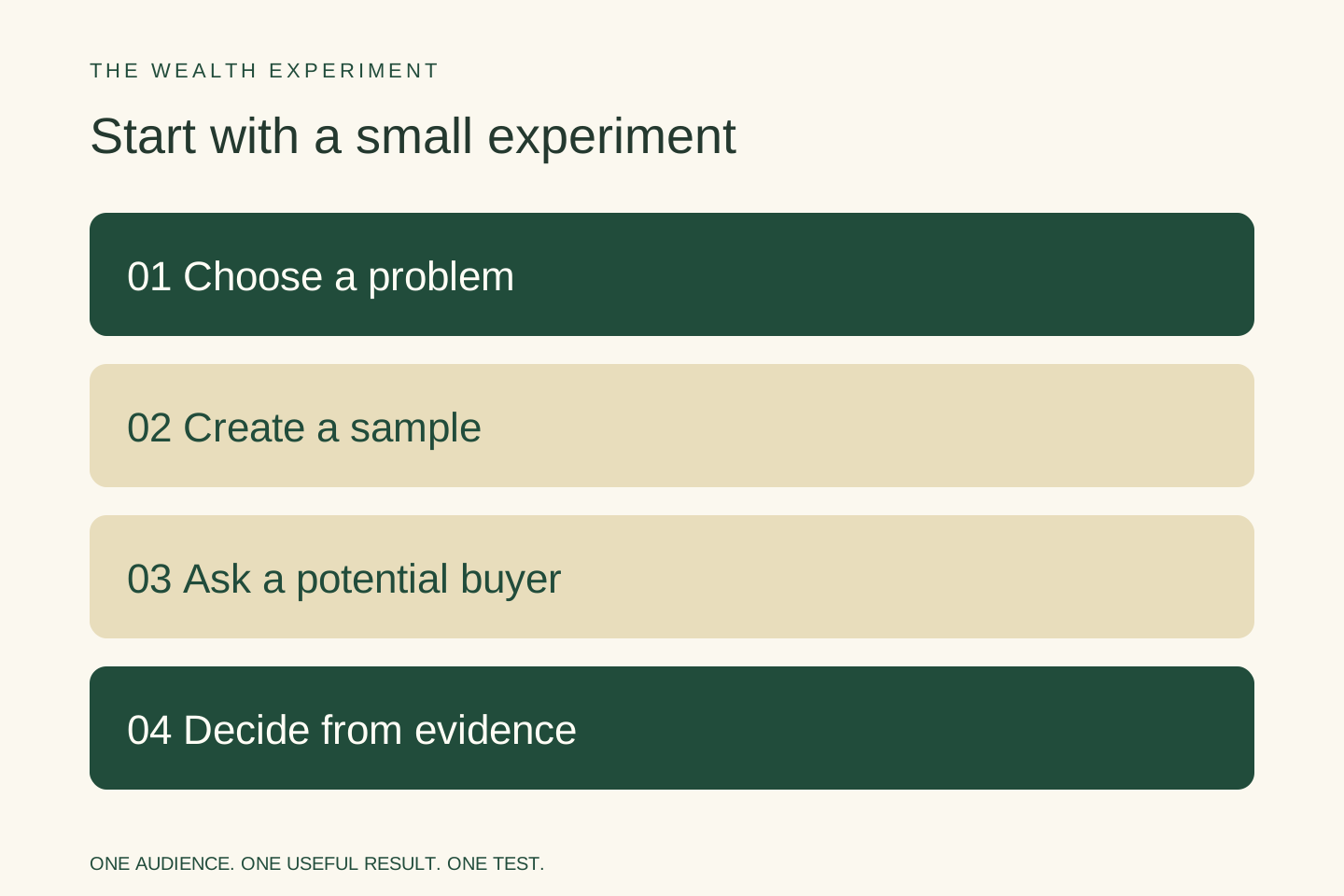 Side-hustle experiments
Will AI pay your bills? Start with a five-day side-hustle test.
Move from a viral income prediction to a useful sample, a customer conversation and a small offer you can evaluate.
October 23, 2026 · 5 min read