Choose & test an idea
Before the Logo, Before the Website: 6 AI Prompts to Test Your Side Hustle
Six hands-on AI prompts to test a side-hustle idea before spending weeks on a name, logo or website. Find a buyer, create a sample and learn from real feedback.
In this guide
- How can I test a side-hustle idea with AI?
- Before you begin: give AI a useful brief
- Move 1: FIND THE EDGE — start with what you know
- Move 2: BUYER FIRST — describe one person, not “everyone”
- Move 3: ONE OFFER — make the promise smaller and clearer
- Move 4: MAKE A SAMPLE — show something useful before you build everything
- Move 5: PREMORTEM — let AI challenge the plan
- Move 6: NEXT STEP — plan a small test with a stop rule
- A small exercise to try today
- Your next move
- Questions you might be asking
- Sources and further reading
How can I test a side-hustle idea with AI?
Start with a skill and a specific buyer problem. Use AI to shape a tiny offer and reviewable sample, then talk with potential customers. Treat AI suggestions as hypotheses until real feedback supports them.
You do not need to master hundreds of ChatGPT shortcuts. You need a few good questions—and a real-world way to check the answers.
Maybe you have a skill you have used for years, an idea you cannot quite stop thinking about, or a little voice that says, I wonder if I could build something of my own. I know how easily that possibility can turn into a stack of tabs, notes and plans that never meet an actual customer.
AI is wonderful at helping us get an idea out of our heads and into a shape we can evaluate. It is not a substitute for customer conversations, evidence or a person deciding to pay. The trick is to use it as a patient thinking partner—not a machine that declares every idea brilliant.
You've probably seen lists promising hundreds of ChatGPT “cheat codes.” A few of those labels are handy. SWOT can ask for strengths and weaknesses; PREMORTEM can expose failure points; TLDR can request a summary. But these are not secret commands. They are ordinary instructions in shorthand. You can always say what you mean in plain English.
Below are the six moves I would actually use if I had one afternoon and wanted to make progress on a side-hustle idea. We'll use a fictional example throughout: a plant-loving hobbyist considering a beginner balcony-gardening guide. The business, buyers, demand and results are illustrative—not evidence that the idea will sell.
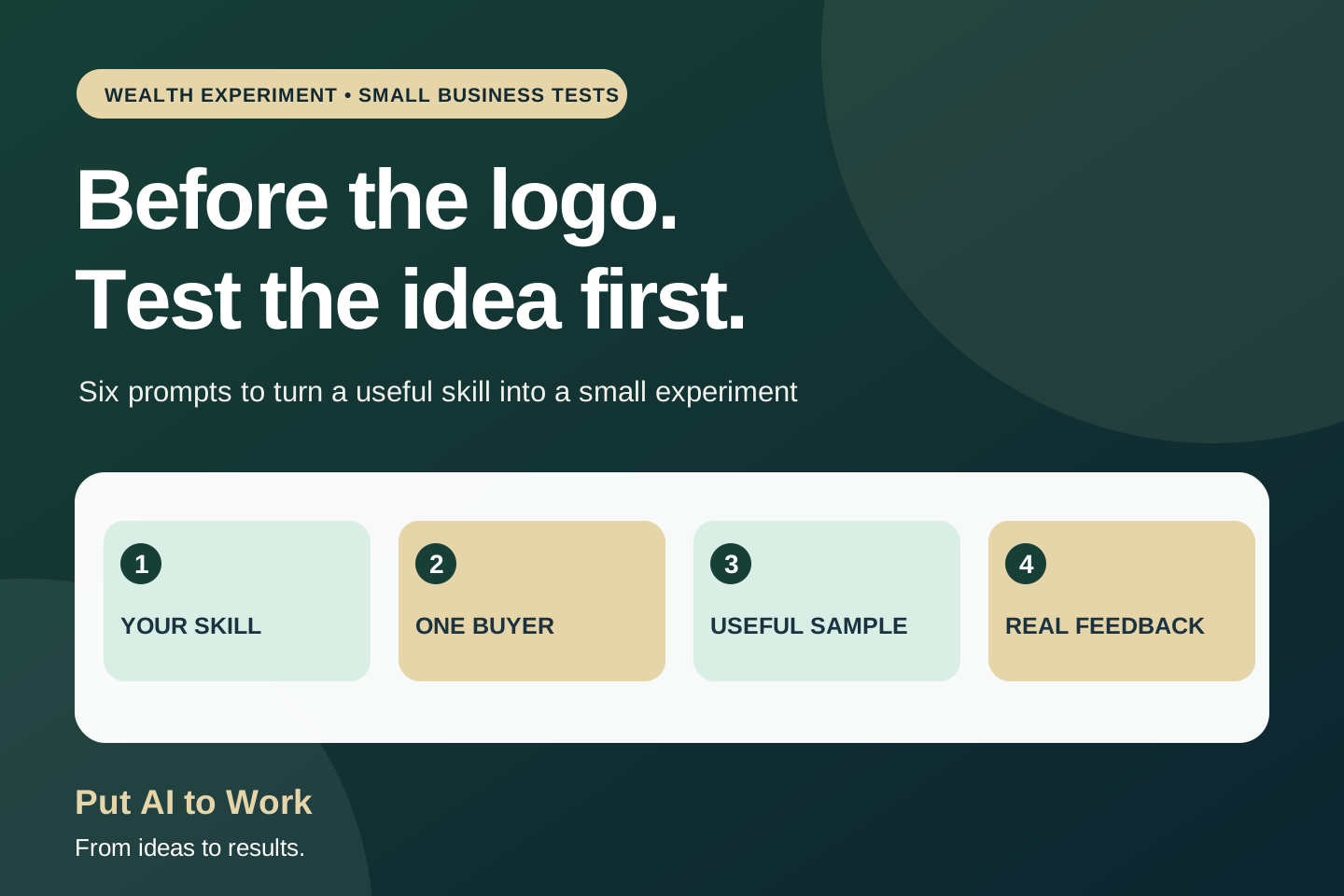
Put AI to Work · Your step-by-step workflow
Start with a real skill
Choose one buyer
Make a small sample
Ask for feedback
Decide what to test next
Before you begin: give AI a useful brief
A good prompt usually includes six ingredients: your goal, who it is for, what you already know, your constraints, the form of the answer, and how it should handle uncertainty. You don't have to use a special syntax. This is enough:
I'm exploring one small side-hustle idea. I know [skill or subject].
I can spend [hours per week] and at most [budget] before testing it.
I want to help [a specific kind of person] with [problem].
Use what I tell you; don't invent customer research or sales.
Give me one realistic first test, three risks, and the information
I should verify before investing more time.
If the answer feels generic, make your context more specific. “People who like gardening” is very broad. “People with sunny apartment balconies who have never kept a plant alive” gives us something more concrete to explore.
Put AI to Work · Your prompt, explained
Goal
Audience
Source context
Constraints
Format
Human check
Move 1: FIND THE EDGE — start with what you know
Instead of asking AI for 100 unrelated business ideas, ask it to help you notice skills and experiences other people may find useful. Don't confuse what you're good at with proof that someone will buy it.
Copy and adapt:
Help me identify three small problems I may be equipped to solve.
My experience: [skills, past work, interests].
I enjoy: [activities]. I do not want to do: [constraints].
My available time: [hours each week].
For each problem, suggest a specific person who may experience it,
a simple service or digital product, and how to test whether it matters.
Do not claim people will pay until I have evidence.
For our balcony-gardening example, an AI might suggest a starter checklist, a small live consultation or a printable plant-care calendar. Those are possibilities, not validated opportunities. Pick one that you could explain in a sentence.
Your checkpoint: Can a stranger understand who it helps and what improves afterward?
Move 2: BUYER FIRST — describe one person, not “everyone”
It is tempting to describe your audience as “anyone who wants this.” That makes it hard to write a useful offer. Instead, explore a real situation, what triggers it and how people solve it today.
My possible audience is [specific group].
The problem I think they have is [problem].
Build a research plan with:
1. Five neutral interview questions that don't lead the witness.
2. Five observable signs of the problem I could look for.
3. Alternative solutions customers already use.
4. Three assumptions that remain unproven.
Avoid invented quotes, demand statistics or imaginary interviews.
You could talk to five balcony gardeners, scan relevant public questions, or offer to help one person with their own space. Ask what they have already tried, what was frustrating, and whether solving it is worth money or time. AI can organize the notes afterward; it cannot make those conversations happen.
Your checkpoint: Record actual words, not AI-invented customer language. Separate “heard from someone” from “the AI suggested.”
Move 3: ONE OFFER — make the promise smaller and clearer
A long course, app or store may eventually make sense. Your first test rarely needs all that. Ask for a tiny deliverable whose value someone can judge.
Based on this observed problem and these notes: [paste approved notes],
propose three small first offers that could each be made in a weekend.
For each: buyer, exact deliverable, required input, delivery time,
out-of-scope work, a sensible way to test interest, and major unknowns.
Recommend one to test first using effort, usefulness and checkability.
Don't make up prices, earnings or demand. Label any pricing as a hypothesis.
Maybe the first offer is “Your First Five Balcony Plants,” a printable decision guide for one climate and sun exposure—not a 200-page gardening encyclopedia. Describe what's inside: a light-check worksheet, five beginner-friendly choices to research, a care calendar and a shopping checklist to verify locally. Avoid presenting general gardening guidance as a guarantee that plants will thrive.
Your checkpoint: Write a one-sentence promise: “I help [person] do [job] with [deliverable], without [main frustration].”
Move 4: MAKE A SAMPLE — show something useful before you build everything
Here is where AI can save real effort. It can help outline, draft and format a sample. The quality still comes from your expertise and your review.
Create a one-page sample of my proposed [deliverable] for a fictional
customer in [situation]. Make it friendly, practical and easy to scan.
Use only these facts and sources: [materials].
Mark anything that needs local or professional verification.
Include a title, three useful sections, one small checklist and a
clear statement that this is a demonstration sample.
Review the file itself. Do the examples make sense? Are the instructions safe and accurate? Could someone use it without you standing beside them? If you are generating graphics, specify their purpose, audience, dimensions and style. Read small text carefully; AI images can look polished while containing errors.
Your checkpoint: Ask an actual person to try the sample and explain what confused them.
Move 5: PREMORTEM — let AI challenge the plan
PREMORTEM is a useful planning label. It means: imagine we tried this and it did not work—what are the plausible reasons? The label is optional; the instruction is what matters.
PREMORTEM: Imagine I spent two weekends building this and received
no meaningful customer interest. Identify six plausible explanations.
Separate problems with the audience, offer, distribution, price,
quality and evidence. For each explanation, give me one inexpensive
check I could run this week. Don't assume the idea is doomed.
Perhaps our audience has the problem but prefers free videos. Perhaps the sample is attractive but too general. Perhaps we have no credible way to reach buyers. These are fixable questions—and sometimes reasons to choose a different opportunity.
Try a follow-up: “What evidence would change your recommendation?” This makes the conversation more useful than simply asking whether an idea is good.
Move 6: NEXT STEP — plan a small test with a stop rule
This is my favorite part. AI helps turn possibilities into a short sequence of actions, with a way to decide what to do afterward.
NEXT STEP: Give me a seven-day test for this offer.
My time limit is [hours]. My no-spend budget is [amount].
Use three stages: build a sample, get real feedback, make a decision.
Include a script for inviting feedback without pretending this is a sale.
Define what I will record: conversations, specific objections, sample
usage, genuine requests and costs. Add a stop, revise or continue rule.
Make the tasks small enough to fit an ordinary week.
For the fictional balcony guide, a plan could be: one afternoon to create the sample, two short sessions to ask permission to show it to potential users, and one review of what they actually did or said. The number of interviews is a plan, not a result. If nobody responds, that is information about this outreach path, not proof the idea will never work.
The “code” glossary worth keeping
| Short label | What you're asking for | When it helps |
|---|---|---|
IDEAS3 |
Give me three specific possibilities and how to test each | Start without overwhelm |
COMPARE |
Compare options using the same criteria | Choose one direction |
SWOT |
Strengths, weaknesses, opportunities, threats | Surface tradeoffs |
PREMORTEM |
Assume failure; identify plausible causes and checks | Reduce avoidable mistakes |
CHECKLIST |
Turn a plan into actions I can check | Start building |
NEXTSTEP |
Give me one useful next action | Break a planning loop |
VERIFY |
Mark claims that need sources or real-world testing | Avoid mistaking guesses for facts |
These names are memory aids. If you invent IDEAS3, define it the first time. No special model feature is activated by typing it.
A small exercise to try today
Set a 25-minute timer. Spend 5 minutes naming an audience and problem, 5 minutes on one offer, 10 minutes making a tiny sample, and 5 minutes writing whom you could ask for feedback. Do not buy software or commission a logo yet. You are trying to learn whether your idea helps someone—not look like a fully formed company on day one.
What to watch before you call this an opportunity
Keep three columns in a note: what I observed, what I assume, and what I need to test. Count actual requests, meaningful replies, and willingness to take the next step. If you charge for a pilot, track your true time and costs so revenue doesn't masquerade as profit. AI-generated projections are not customer evidence.
Where AI can help: choosing questions, organizing notes, writing a prototype, comparing ideas, drafting outreach. Where you decide: whether a need is real, what promises you can keep, what to charge, and whether to continue.
Your next move
Bring your one-sentence offer and sample into Experiment Studio to keep your test organized. If you'd rather build alongside other people, explore Two Mondays to a Side Hustle for guided practice and feedback. You don't need to have it all figured out. You need a first experiment small enough to learn from.
Further reading: Vruddhi Shah's overview of community prompt shortcuts, “400 ChatGPT Cheat Codes Nobody Lists in One Place”. The prompts and worked example in this guide are original, and the example is hypothetical.
Questions you might be asking
Do these shortcut words turn on special ChatGPT features?
No. Most are informal labels for ordinary instructions. Define what you want in plain language and check the result.
How many prompting techniques should I learn first?
Begin with two or three that solve tasks you actually do. Practice, compare the results and save the wording that works for you.
Sources and further reading
Sources checked October 24, 2026. Review the linked publisher information for current details.
Put one idea to work
Use the idea revival worksheet to turn a recurring interest into a small test with a clear decision.
Choose an idea worth testing →Explore more from Wealth ExperimentGet the Wealth Experiment field notes →Keep practicing
 AI agents · A practical field guide
How AI agents work—and where to start
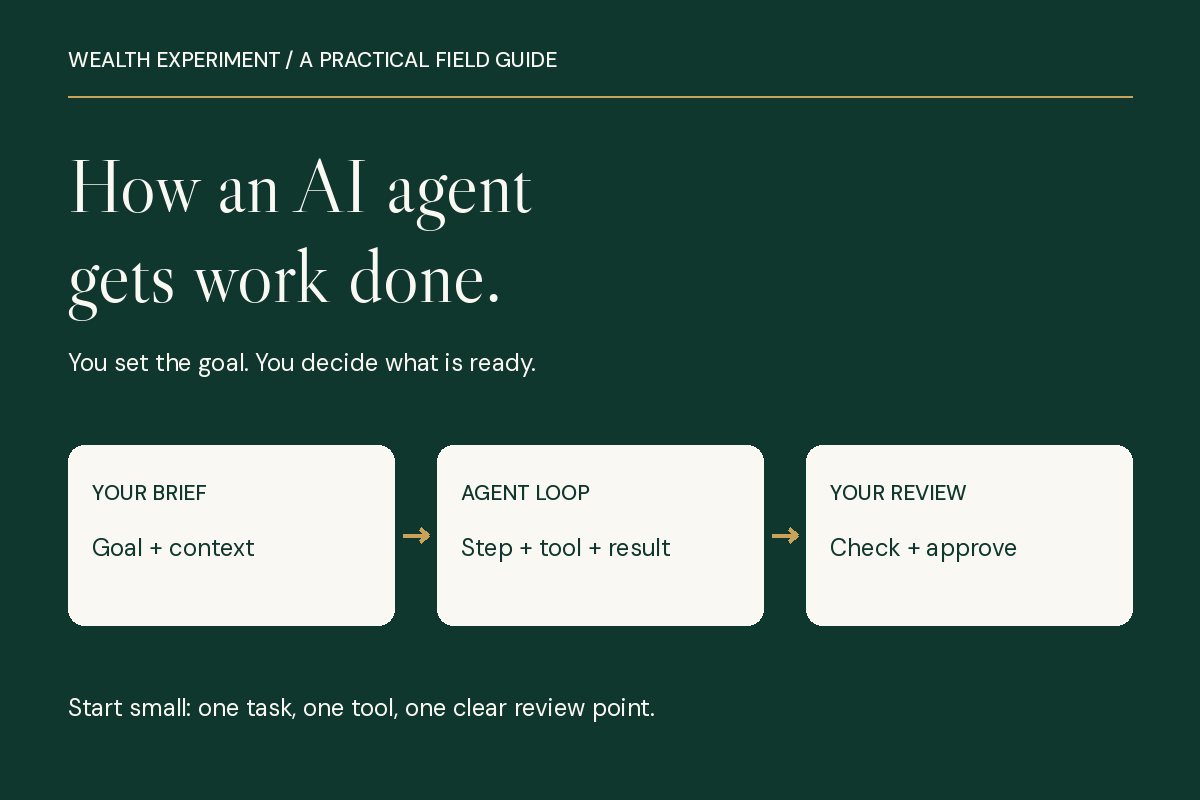
Give an agent one useful job. Understand the loop, harness, tools, plugins, tokens, and human checkpoints—then try a workflow for your day, your work, or a small service.
October 24, 2026 · 11 min read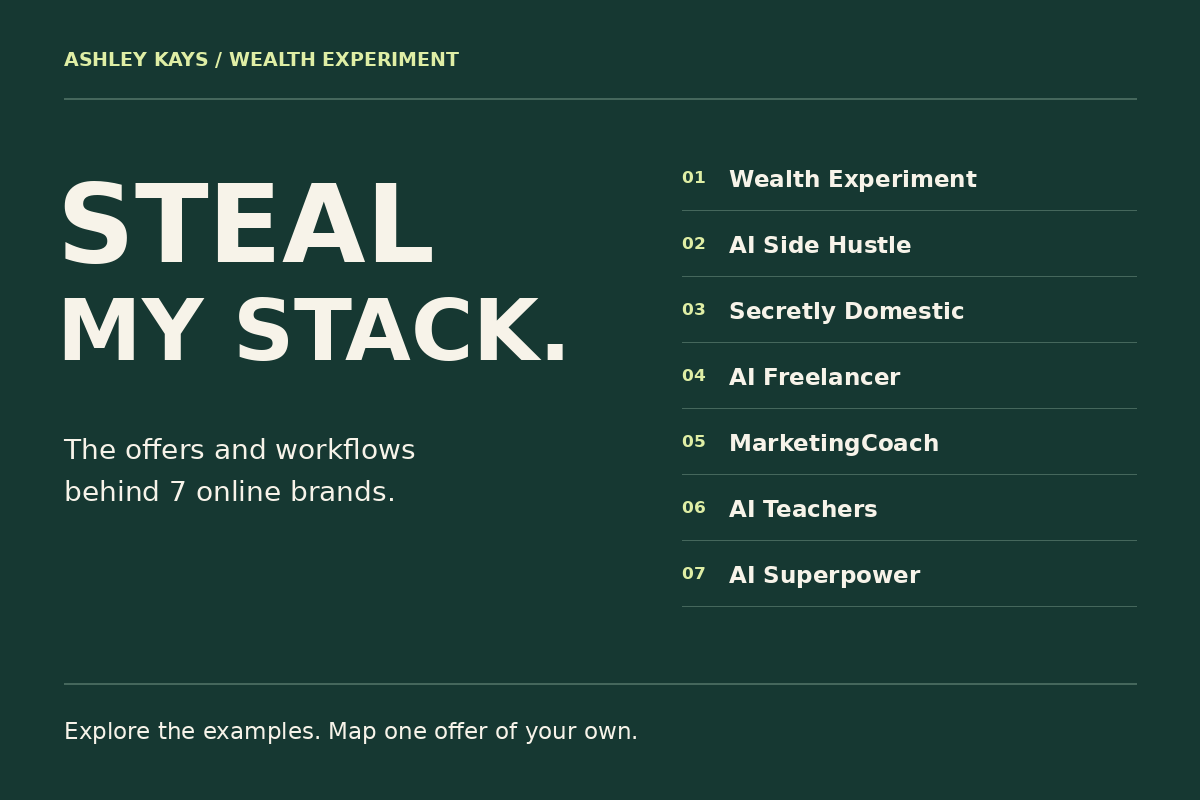 Build with Ashley
I built 7 online brands. Here is the map behind them.
Steal the thinking behind seven brands: the customer, offer, tools, workflow, and next useful test. Get the free map and shape an offer of your own.
October 23, 2026 · 5 min read