Client delivery
How to write a client recap when the call ends without a clear yes
One line in a follow-up email can change what a client thinks you promised. Try editing a fictional recap against the notes that produced it.
In this guide
What belongs in a client recap?
Send the decisions people actually made, the actions they accepted, and the questions someone still needs to answer. Keep a private line back to the source for each commitment.
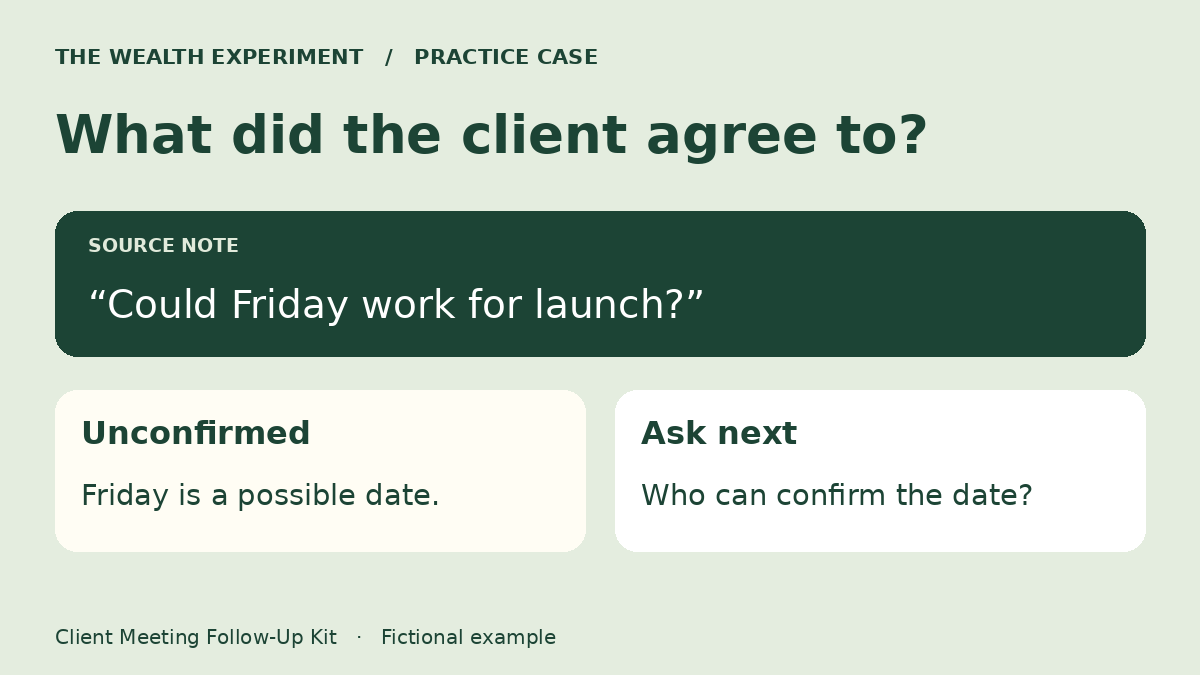
A client says, “Could Friday work?” Your follow-up says, “We’ll launch Friday.” Both sentences sound reasonable. Only one matches the call.
Read the last minute of the call again
In the Oak Studio practice case, Sam agreed to draft a one-page guide. Jordan agreed to send approved screenshots by Wednesday. Friday came up as a possible launch day. Nobody gave Sam a draft deadline. An FAQ was suggested. The team agreed to use its existing signup form.
Edit the risky sentence first
Try editing this draft before you read on: “Sam will deliver the guide Friday, including the FAQ.” It introduces a deadline, changes a possible launch date into a draft date, and folds a suggestion into the scope. The source only supports one commitment here: Sam will draft the guide.
Write the version you can send
“We’ll use the existing signup form. Sam will draft the guide. Jordan will send the approved screenshots by Wednesday. Sam, when can you share the draft? Can we confirm whether Friday works for launch and whether to include the FAQ?” Asking three precise questions gives the team three decisions it can actually make.
Handle a correction after the email goes out
Suppose Jordan replies that Wednesday applied to a low-resolution preview. Leave the original record intact. Add the correction with its source, send the updated line to the people depending on it, and leave the date for approved screenshots open. This keeps the next handoff from repeating the original error.
Try it on the next call
Use a permitted set of notes. Underline every date, name and promise in your draft and find the sentence that supports it. If you can’t, rewrite it as a question. Ask a colleague to compare your draft with the notes, then record the first change they make.
Try the two-page sample
Start with the Oak Studio notes, then use the blank evidence sheet for a call of your own.
Get the Client Meeting Follow-Up Kit sample
Put one idea to work
Use the idea revival worksheet to turn a recurring interest into a small test with a clear decision.
Choose an idea worth testing →Explore more from Wealth ExperimentGet the Wealth Experiment field notes →Keep practicing
 Agent-friendly websites
Agent-Friendly Website: A Small Business Test You Can Run
Run a bounded agent-readiness experiment with a baseline, a short llms.txt file, a test log and an honest decision about what to do next.
November 11, 2026 · 8 min read AI browser workflows
Before you buy another tool, put your open Chrome tabs to work
Use ChatGPT to compare three software pages, check the full cost, and make one practical decision for your side hustle—with five illustrated steps and prompts to copy.
November 11, 2026 · 8 min read