AI service experiments
Turn one agent workflow into a service people can evaluate
Test an AI workflow service with a defined buyer, a clear deliverable, a small pilot and evidence of quality, cost and demand.
In this guide
- The useful starting point
- Start inside your existing expertise
- Build a demonstration before a big automation
- Sell a bounded pilot
- Choose the tool after the delivery requirement
- Include the cost of your attention
- Use a two-week experiment
- Grow the responsibility gradually
- Your first move
- Questions you might be asking
- Sources and further reading
The useful starting point
Start with a recurring task you understand and a buyer whose problem you can verify. Build a labeled demonstration, scope a small pilot, and count delivery, review, software and support costs before expanding the offer.
A practical way to explore an AI-related side hustle is to start with a piece of work someone already needs done. Choose a result you understand well enough to deliver and check: a weekly research brief, a reviewed FAQ update, a client intake summary or a consistent reporting pack.
The opportunity is not established by calling yourself an agent builder. It becomes testable when a prospective buyer can understand the problem, inspect the deliverable and decide whether it is worth paying for. Use agents to help produce the work, while keeping responsibility for evidence, quality and commitments.
Start inside your existing expertise
List three recurring tasks you know from work or a project. For each, name the person who uses the result, what happens when the task is late or wrong, the inputs required and the review standard. Select a task with available, permitted data and a bounded finish line.
For example, a marketer might offer a sourced campaign-research brief. A designer could prepare a clearly labeled synthesis of supplied interview notes. An operations specialist could improve an intake handoff. These are illustrative service ideas, not claims about proven demand or typical earnings.
Build a demonstration before a big automation
Use fictional or approved material and show the complete chain: the task brief, context, agent output, checks, corrections and final handoff. Label a fictional sample as a demonstration. Preserve the source references so another person can see how the result was produced.
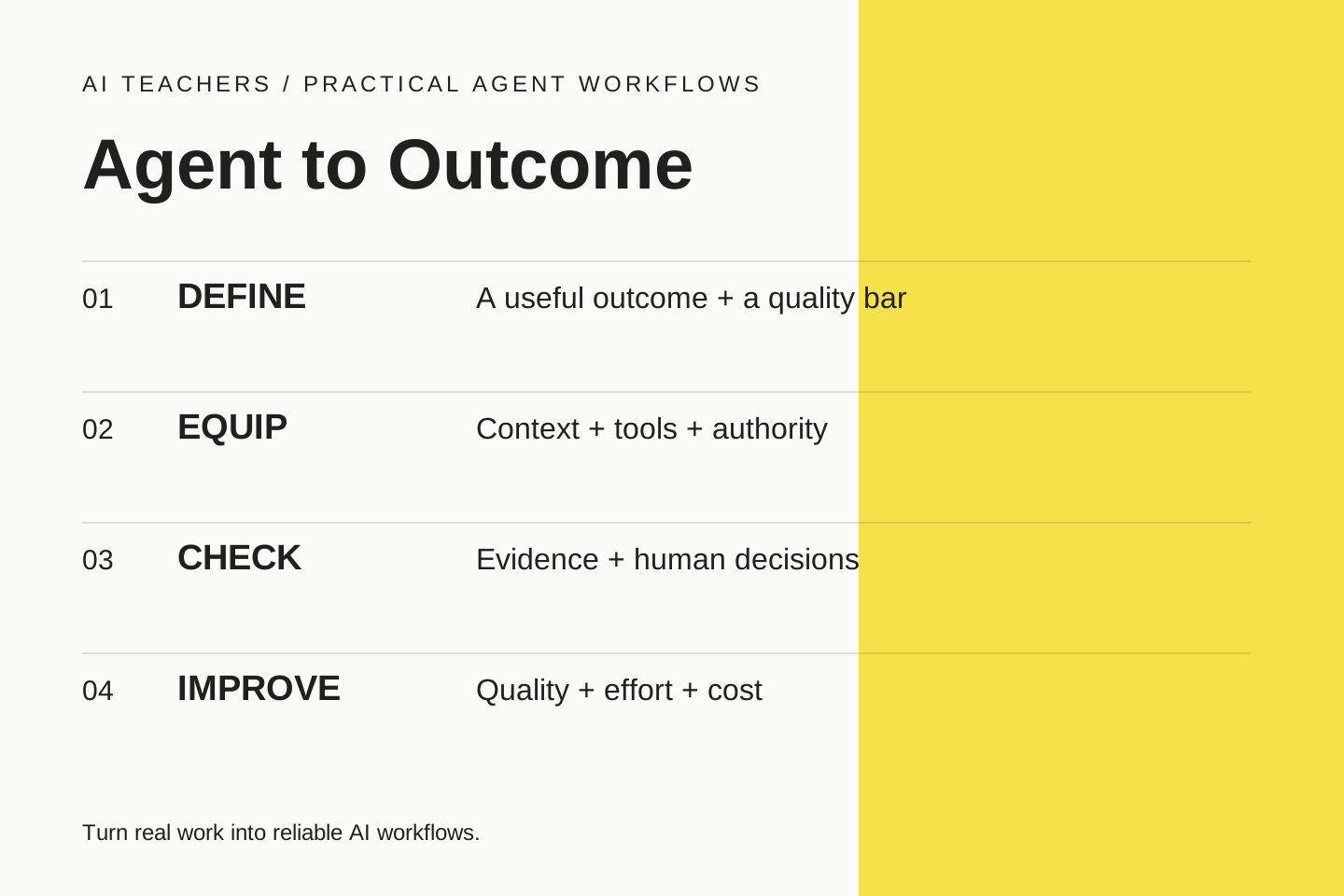
The free Agent to Outcome tutorial provides a useful practice task. Its workflow planner helps you document the goal, data, tools, human checkpoints and operating limits. AI Teachers is another learning site by Ashley; the core tutorial is free.
Sell a bounded pilot
A clear pilot offer might be: “I will use your approved source material to prepare one weekly client brief, review every action against its source, and deliver a reusable brief template and operating notes.” State the number of examples, turnaround, review rounds and acceptance criteria.
Separate delivery from access. A buyer can evaluate a document-based pilot before granting account connections. Live sending, production databases, sensitive records and ongoing monitoring require their own scope and controls. Agree on who owns the accounts, pays the software bills, reviews output and can stop the workflow.
Choose the tool after the delivery requirement
Task-oriented workspaces can help make briefs, spreadsheets and other artifacts. Persistent agents can support an ongoing responsibility. Coding tools suit technical changes. Workflow builders help when triggers, validation, human review and writes must follow an explicit sequence.
Use one approved product well before buying several. Compare it on a small, representative task. Review the current agent guide for Work, Cowork, Codex, Claude Code, Dots, Muse, Duet, Grok Bot and orchestration tools. A product’s feature list does not establish that it fits your client’s data or operating environment.
Include the cost of your attention
Track research and setup, client communication, preparation, agent execution, review, corrections, handoff and support. Include subscriptions, API calls, retries, tool charges and payment or marketplace fees that actually apply. A quick first draft can still be an expensive deliverable if you repair it repeatedly.
Evaluate the cost per accepted result. If five attempts produce two usable outputs, the cost of the other three belongs in the calculation. Record uncertainty rather than claiming a universal saving. Use a short trial to learn where your judgment creates value and which parts can safely become repeatable.
Use a two-week experiment
In week one, choose a buyer and problem, speak with a small number of relevant people, and build one labeled demonstration from permitted inputs. Ask what they do today, what goes wrong, how they evaluate the work and who controls the budget. Do not substitute synthetic personas for real conversations.
In week two, offer a small pilot with written scope and acceptance checks. Observe whether people agree to a concrete next action or paid engagement. Track all the time and cost. After delivery, ask which part was useful, what still needed correction and whether the workflow belongs in their routine.
Grow the responsibility gradually
A useful progression is assisted delivery, then a reusable workflow, then a connected workflow with approvals, and finally a maintained system if the buyer needs it. More agents and integrations are justified by evidence of a bottleneck, not by how impressive a diagram looks.
Potential career directions include AI enablement, workflow analysis, implementation, agent evaluation and software engineering. Your portfolio should show what you owned, what the agent did, how you checked it and what changed. Tool names can change; a demonstrable ability to improve work is more durable.
Your first move
Use the Wealth Experiment AI team planner to select a responsibility, then take the free Agent to Outcome tutorial. The paid workshop adds guided practice; Waymaker Agency provides implementation and team services.
Begin with a service you can deliver and a buyer whose problem you can verify. The experiment may show demand, a need to revise the offer or a reason to stop. None of these steps promises income, clients or employment.
Questions you might be asking
Do I need a new AI subscription?
No new product is required for the basic document exercise. Use an approved assistant you already have, and verify product access and costs before a connected workflow.
Does the workshop include production automation?
The core workshop develops and tests a bounded workflow. Production connections, ongoing operations and broader implementation are separately scoped.
Sources and further reading
- Anthropic: building effective agents
- Anthropic: evaluation against actual agent outcomes
- OpenAI: agent usage and observability
- OpenAI: ChatGPT Work
- Anthropic: Cowork and Chat transition
- MCP: architecture
Sources checked October 22, 2026. Review the linked publisher information for current details.
Put one idea to work
Use the idea revival worksheet to turn a recurring interest into a small test with a clear decision.
Choose an idea worth testing →Explore more from Wealth ExperimentGet the Wealth Experiment field notes →Keep practicing
 Learning in Public
Keep a Daily AI Learning Log That Turns Experiments Into Better Decisions
Record useful AI experiments with inputs, checks, complete effort and next decisions so learning compounds beyond a collection of saved chats.
October 22, 2026 · 5 min read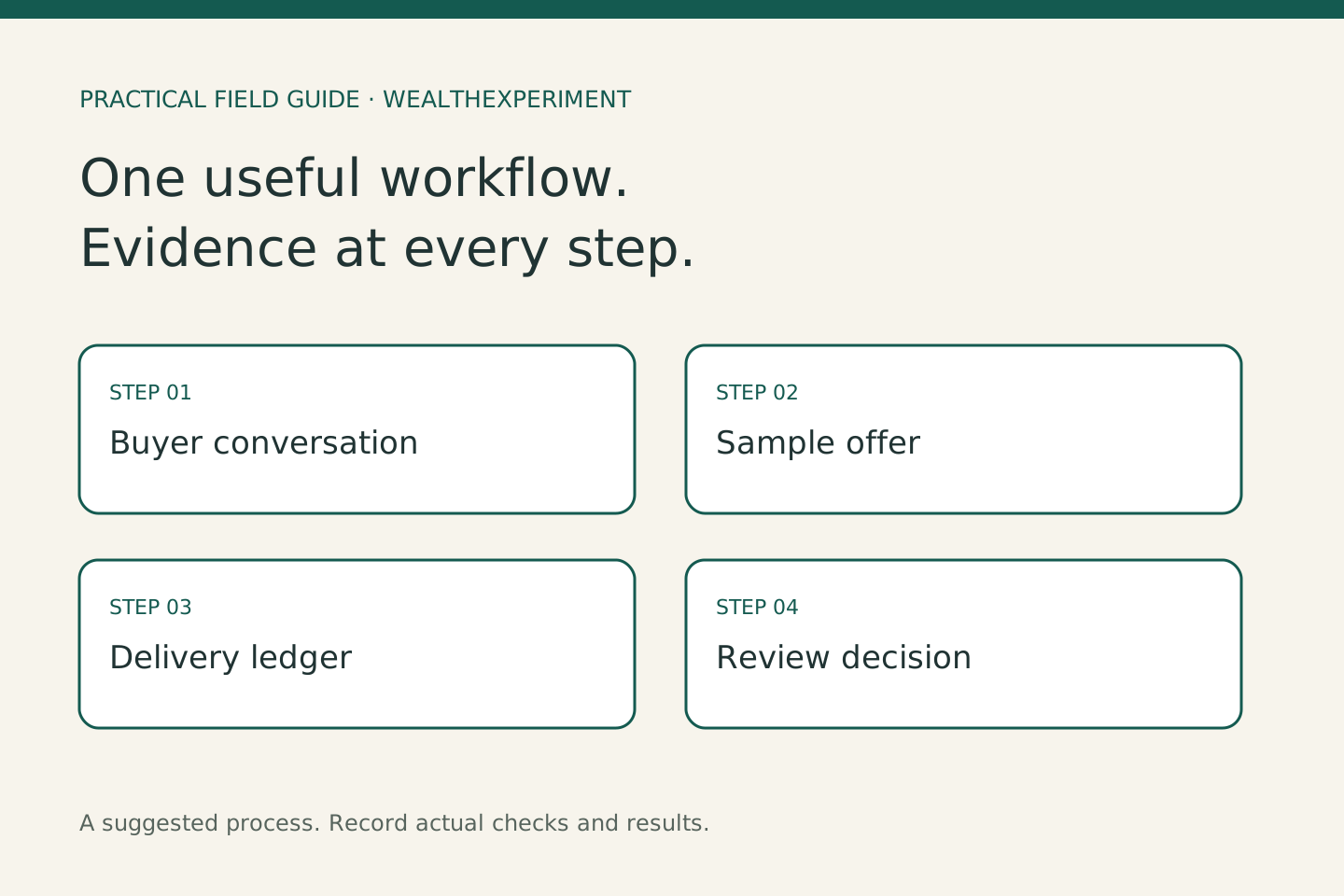 AI and commerce
Test a small Shopify support service before building another business
A bounded Wealth Experiment: offer a product-page review, measure delivery effort and use Grok Bot only where it improves the work.
October 21, 2026 · 4 min read